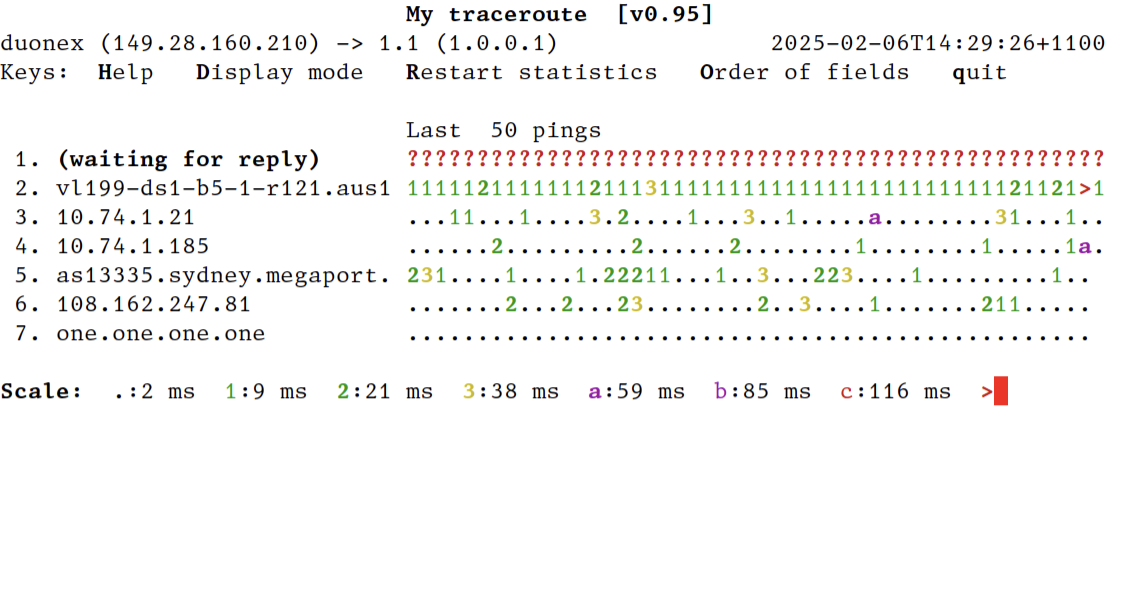
I normally have `mtr 1.1`¹ running in the background, in the third display mode, which is a 2D histogram—time in the x axis, hops in the y axis, and ASCII character/colour for ping time. When problems occur, this tends to let you easily see the nature of the problem—total loss, elevated packet loss, elevated response times; and to see the location of the problem—local network, local ISP, public internet. There are definitely occasions for loss%, sent, last/average/best/worst/stddev ping and such things as are found in the first display mode, but most of the time I find the histogram view most useful as the starting point.
You can make mtr start in this view with --displaymode=2 (direct command line arguments, `mtr --displaymode=2 …`; or shell alias, `alias mtr="mtr --displaymode=2"`; or set environment variable MTR_OPTIONS=--displaymode=2).
Animals might not have the emotions for the same reasons, but they do exhibit the whole range we do. Anyone who's ever had an animal that can come and go roughly as they please, will know that they struggle with indecisiveness in all the same ways. Let me out, oh wait, actually never mind, let me in. Or out. Or let me in a little, I will keep one half of me outside and the other half inside, blocking the door.
Original works of art that don't conform to the conventional norms of their time are likely to be panned by critics and ignored by the public at first. Only with the passage of time are we able to reevaluate more objectively those works of art which are truly original. In the cacophony of the moment, it's hard to distinguish genius from folly.
By all accounts, "Megalopolis" is an original work of art that doesn't conform to today's conventional norms. Only with the passage of time will we be able to recognize if it is genius or folly.
Now I'll throw out another completely unprovable thought...
Perhaps consciousness has the ability to affect how wavefunction collapse occurs, perhaps it even has the ability to influence the observed outcome.
I'm not going to try to prove these two ideas but together they can help form an idea that perhaps observations on the past actually influence the past and perhaps despite this 'observation after the fact' there's still free will.
It's not provable but then neither is the "there's no such thing as free will" arguments that this sort of research leads to. The point of the above is to highlight that there's still a way out for free will.
They're most obvious with "basic" products like energy and comms - in theory what is delivered is mostly undifferentiated kWh or GB but through the magic of "confusing plans", marketers have succeeded in making comparisons very difficult for regular people.
(You can do it, but you need OCD, a year of billing data and a spreadsheet - which greatly exceeds the cognitive effort most people will invest in choosing a mobile or energy provider).
The US healthcare sector seems to be the largest, most intricate and most successful (in terms of gdp extraction) confusopoly in history.
I suggest everyone to carefully read the replies of the Facebook employees in this thread.
These data are being released in hopes of furthering the developments of these techniques - which ultimately benefits a future use by Facebook.
In turn, people like "presenti" have pointed out several times that the data were collected in Facebook offices or other places where all participants consent. The implication is clear: While the present data are legal, they would not be if shot in the "wild".
In many jurisdictions, there is no legal use case for these methods. It is literally not possible to have a widely-used implementation of these glasses that would not violate the privacy rights of "bystanders".
Of course, Facebook will work hard to make it legal, on all fronts. Whether laws need to be changed or, as pointed out by presenti, some innovation may arise to make you at least an anonymous blob, separate from name and address. And if you do not have an account - see in this thread - what is there to worry about?
Well, even if the association would only be indirect, any data collected from you (with increasing sophistication) would be part of Facebook and its models. Even as a group of anonymous users, you would become less and less anonymous and increasingly more explainable.
If you are so far unconvinced that this matters, please be also aware that the only thing standing between businesses and the extraction of the entire surplus (or consumer welfare) is asymmetry of information.
As soon as your needs and wants are sufficiently modeled, companies will use these data to maximize the profit from all their interactions with you. You will, in a sense, pay monopoly prices without facing monopolies.
Again, read the replies carefully. See how legal constraints are certainly something that is "to be solved in the future". However, whether you should ever be afforded privacy or anonymity in the face of facebook's algorithm is implicitly answered, with (frankly) a worrying amount of arrogance and dismissal: no, you and everything about you should no longer be any unexplained variation for facebook. One way or another, facebook plans to uncover you, and there is no negotiating this point.
You must now realize that Facebook is not interested in your name and birthdate, they are interested in being able to predict everything about you without these personal data. Faeebook wants a model, one that is fundamentally opposed to your welfare. And this objective will be realized.
Take heed of this, better now than later.
As I get older, the less I identify as my current state and the more I identify with the person who transitions through states. My change in perspective has reduced my anxieties and anger significantly. "This too shall pass" and all that. The more of my self image is focused on superficial things, the more I will take things personally. What we are angry about tends to be a reflection of ourselves more than the current state of affairs.
If I see myself as a busy professional I might be much more aggravated by someone at the grocery store holding up the checkout line with EBT (since I am busy they must be lazy!). If I see myself as a social climber I will always be worrying if people are using me for something (since I am using them!). If I identify with my wealth I might develop some neurosis regarding the sight of the homeless (since they represent ultimate failure!).
I don't believe in reincarnation but it is a helpful thought experiment to think about what benefits and drawbacks your particular incarnation of life holds and how those might be different if you were incarnated elsewhere.


- AppFlowy: https://github.com/AppFlowy-IO/AppFlowy
- AFFiNE: https://github.com/toeverything/AFFiNE
- SiYuan: https://github.com/siyuan-note/siyuan
- Trillium Next: https://github.com/TriliumNext/Notes
- AnyType (only clients are source available): https://github.com/anyproto/anytype-ts