Anxiety is complicated. For example, having airline crew on Ebola-grade hazmat suits emblazoned with biohazard logos would probably reduce COVID transmission by some fraction of a percent, but it would also increase anxiety for most of us. If you take the LA Blue Line (which goes through some of the worst neighborhoods in the city), the constant announcements about your safety being important and occasional patrols by jackbooted commandos are the opposite of reassuring.
Basically, it's difficult to show you care about a problem without making the problem appear worse.
In many languages the distinction is quite blurred. In Japanese, most color words like 茶色 chairo (brown), 灰色 hairo (gray), 黄色 kiiro (yellow), 紅色 beniiro (crimson/red) incorporate the word "iro" (color), but while the first two are tea-color and ash-color, ki 黄 and beni 紅 now just mean "yellow" and "red" respectively.
It looks like 黄 and 紅 never had a distinctive non-color meaning (as characters) without 色, so maybe using them without 色 is more a recovery of their historic meanings rather than an invention of a new meaning?
(That's just a guess, I especially don't know the roles that written and spoken forms have played in the evolution of these meanings, or whether spoken "ki" and "beni" did or didn't have independent meanings.)
I can provide some non-native commentary on modern Mandarin Chinese. All color terms are most ordinarily used with 色 ("color"); it is unusual, though possible, to use a color term by itself.
It doesn't seem like a big stretch to imagine that this was also true when the terminology was borrowed into Japan from China, and that's why the 色 gets used in Japanese.
I can't claim to be an expert, but this is likely correct. The native Japanese words for color (shiro, kuro, aka, ao, midori etc) don't use the -色/iro suffix.
Japanese has the cool feature that you can clearly identify siro/kuro/aka/ao (a fairly typical four-way white/black/red-yellow/blue-green distinction) as the most basic colour words with relatively little diachronic analysis: they're the ones that stand alone in the rather limited class of 形容詞 ("i-adjective") stems.
You can almost trace the development of colour terms through the vocabulary strata...
Note that you still can use the the iro/color suffix for aka (red), ao (blue), midori (green), you just don't have to and they also function as standalone adjectives.
E.g. akai (赤い) -- red (adjective) vs akairo (赤色) -- the color red (noun)
compare: chaiiroi (茶色い) -- light brown (adjective) vs chaiiro (茶色) the color light brown (noun) -- literally "tea color"
In the dialect I speak (roughly North Central American), syringe has the stress on the second syllable, which makes the rhyme with orange (ˈôrənj, ˈärənj) a bit awkward. Looking it up, I was surprised that both stress on the first syllable and on the second were listed.
səˈrinj, ˈsirinj
It piqued my curiosity. May I ask where you've heard the latter?
It's generally in the range of /ɪ/~/ɨ/. Descriptions of English regularly conflate the ɪɛʌ with ə as they behave somewhat similarly wrt stress-related sound changes.
I agree with the issue of stress, but it seems less problematic to me than the vowel mismatch. Orange and door use the FORCE vowel in their first syllables. Syringe doesn't; it uses NURSE, and this is enough to prevent the words from rhyming.
(Perhaps you view orange as using the START vowel in its first syllable. That's still not NURSE and still doesn't rhyme with syringe.)
The rhyme has to be from the last accented syllable (otherwise "tinge of fringe in your minge" are rhymes), so syringe isn't, and door hinge only works if you make it a compound word and make hinge unaccented, which means dropping the h. At that point you're in near rhyme territory.
> door hinge only works if you make it a compound word and make hinge unaccented
Rhymes are often judged in the context of spoken language, under which conditions, dropping the h and having hinge be unaccented relative to the preceding door wouldn't be unreasonable or uncommon.
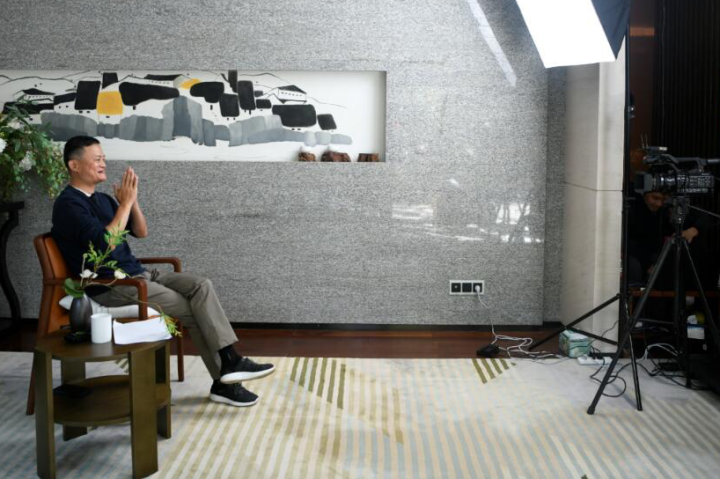
With all due respect, you are presumably also not the multibillionaire CEO of one of the world's largest Internet companies.
If I saw Zuck, Satya or Sundar do a video conference looking like they're chained to the radiator in somebody's basement, I'd also be kinda concerned. (At least for the latter two. Zuck, maybe not so much.)
With all due respect if we judged people by their appearances we'd have discredited Paul Graham long ago for eschewing the traditional VC outfit.
The OP's comments about the appearance of the video is completely irrelevant and merely serving to throw speculative shade. For what it's worth, something probably did happen but his choice of webcam + background probably has nothing to do with it, but rampant speculation and false information is how we lead to the capital riots.
While the idea of gulags and "re-education camps" pervade Western perceptions of Chinese life, the reality is that conformity and centralized government is probably more dull than you think.
Yes but he was comparing to how Bezos and Musk appear.
Everyone is not how they normally appear because of the pandemic, and Ma addresses the reason why he's just video taping himself in a room because of this. Stop armchair speculating.
The odd outbreak aside (and Shijiazhuang is nowhere near Hangzhou), lockdowns are long over in China, there's no need for Ma to cower in a basement.
That said, I actually agree with you that the "hurr durr CCP torture cell" comments are overblown. It's entirely plausible that he's keeping a low profile for a while, if likely in response to some rather heavy-handed advice.
My problem is the OP is trying to insinuate things based off pure speculation, cultural bias, and irrelevant details. He may as well have said that there was an excess of red pixels in the video and that means it must be reflections off of communist symbolism in the room.
So yes we are in agreement that the OP's comment is adds no substance to the conversation and is pure "hurr durr CCP torture cell" that just furthers the stereotypes of China.
No, we're not in agreement on that. It's clear that Ma's dress & appearance in the video was distinctly at odds with his own usual profile, no need for any stereotypes or comparisons to other people.
He upgraded from sweatpants to khakis. I think people are over reading the situation. All the usual factors that gets someone disappeared is not present with Ma's current faux pas.
Yes but he (OP) was specifically comparing to how Bezos and Musk appear and insinuating that someone from the Chinese culture must present themselves in the same way or there must be foul play.
Just to clarify, I'm not really in a position to analyze the meaning behind his current attire and choice of background relative to his past, so I'll take your word on your analysis of that.
Mainland China's growth has been much slower because the madness of Mao's misrule set the country back by several decades. If you compare the country's growth since Deng Xiaoping took over and started reforming in the early 1980s, it compares much more favorably.
Yes, China punches under its weight in software, and yes, China's services are not particularly visible in the US, but I assure you they're already making a huge impact, particularly in the developing world, and that impact is only going to growing in the next 5-10 years.
Alibaba/Aliexpress are massive for consumer online shopping, particularly in Russia & Eastern Europe. Alipay payments are increasingly accepted across SE Asia. JD.com (which nobody ever hears about, but is considerably larger than Ali) operates directly and indirectly in many SE Asian countries.
Tencent Games owns and operates a huge slew of globally popular games, including Fortnite, League of Legends, the Supercell suite (Brawl Stars, Clash of Clans etc). Yes, most of these games are still produced primarily in the West, but for long?
Trip.com has been run out of China since 2017 since it was acquired by Ctrip. Meituan/Dianping dominate food delivery in China and are started to branch out to other markets like Australia and Singapore.
Is this meaningfully different from the user's point of view than just subscribing to a set of different subreddits? What does the user or the host get out of using federated servers?
From my POV this seems to be the same issue that has prevented federated social networks or chat services from taking off: there's no meaningful, concrete advantage to it.
I'm the developer behind littr.me. In my mind, the best reasons for migrating to your own service as a reddit community is the fact that you get ownership of it. You can monetize, you can enforce rules that are different to reddit's, you can focus your interface more specifically towards custom UI, etc.
The main downside of moving off reddit would be that you lose access to the larger pool of reddit users and communities. That however is mitigated by the fact that federated communities can still interact with each other despite being independent services.
Personally this would be my main goal for the project: managing to get one of the cool subreddits to leave reddit in favour of starting their own independent community using my code. However some of the things that are made easier by the centralized model of reddit are quite more difficult in the federated case (moderation as an example), and I don't feel confident (yet) to push for this.
Consider as a part of user experience the ability to select your own admin and mod teams and terms of service by choosing a server on which to participate, or even be your own admin and mod team by launching your own server, without having to sacrifice access to a larger userbase. This changes the user experience considerably and is a definite draw.



Basically, it's difficult to show you care about a problem without making the problem appear worse.