Discord has some structures and dynamics that really work against it for the sort of communities IRC excels at.
The standard Discord experience has you look for and join a "server", each of which is meant to feel like distinct island. This has every server duplicate the same set of boilerplate #general, #off-topic etc. channels, as if there are no others. As a result the vast majority of servers are fairly dead and barren, the userbase is spread too thin. Also because the UX makes switching between servers a fairly heavy context switch, so monitoring this deluge of channels is not fun and nobody can stay on top of all of their servers.
I once looked around for maker-y/electronics Discords, and joined probably 7-8, and they were all dead. ##electronics on Libera is highly active.
Also, once you create a channel in Discord you cannot get rid of it without destroying chat history.
With IRC, you just /part without disrupting other people and even then you can go back and read chat logs, nicely persisted on your local disc as text files.
> Also, once you create a channel in Discord you cannot get rid of it without destroying chat history.
This is true; the closest thing you can do is collapse the category that channels are in, and mute the ones you don't want to show up. Any new conversation in a channel will pop them out.
True, but the channel still stays visible for everyone else, including new users.
To have IRC-level feature parity, the deletion action should make the channel read-only, visible only to past participants and push it down on the channel list, preferably under a special archive category that is collapsed by default. This can of course be done manually, but especially the permissions part is tricky and it still allows other people to nuke your chat history retroactively.
If you think about it IRC is the same, but making an IRC server is much harder so nobody does it, while creating a Discord server is so easy you'll have too many.
IRC is also different in the sense that it is federated, but when most people think about an IRC "server" they actually think about "networks".
i think this is not an easy problem to solve.
but this has been a big enough of an itch for me and i've got some time on my hands these days so i'm building www.ever.chat for anyone interested to take a look.
if anyone wanna chat, stop by and/or hit me up on X!
As treasurer of a similar FOSS org, this is the correct take.
An important responsibility of the people running a FOSS community's backing non-profit is to keep the org safe and stable, as the community relies on it for vital services and legal representation. A risk like that is unacceptable, even more than in commercial business.
Typically in grant work you submit a complete proposal with milestones and roles defined, and receive payout over time to cover the costs in the plan, or some part of them. It's earmarked money.
In more established non-profit areas there's usually also quite some compliance overhead and audits to be passed, so this can be someone's fulltime job on the org side. FOSS backing orgs are typically smaller and less experienced, so donors have so far found ways to make things easier for them and give more leeway.
> What luxury some people have to reject $1.5 million.
For a non-profit backing a community, an important goal is to ensure the long-term sustainability and viability of the org, because the community relies on it to keep infra working, legal representation in place, and other vital needs.
Accepting those $1.5mio would have come with significant "we want that money back" risk, as the post explains. At a $5mio annual budget that could seriously destabilize a small org like this, from the money shortfall to community unrest. Taking this money would be irresponsible.
My two cents, as treasurer of another large FOSS non-profit.
Bummer about the funding (and for a small org, almost more importantly the wasted application work), but all around an excellent decision. And a good reference for non-profit backbone.
I have one of those jobs, and I don't contribute a lot of code at work anymore (sometimes, when it makes a difference or I can help save a lot of time).
I still write code almost daily however, e.g. for personal projects or in FOSS. For one, I love it as an activity - writing code is stress-relief for me. If I don't do it for some time I really feel deprived. I also think it's necessary to keep the first-hand knowledge of stacks and tools alive and well, e.g. for effectively communicating with engineers in a way both sides will enjoy.
I also do still make a point to e.g. do a MR regularly at work, partly to make sure I know the processes and their pain points, also so I can use my clout to complain if we make engineers waste time with stupid stuff, as processes also tend to accumulate cruft over time.
And obviously I don't think of writing code as a "lowly activity". Quality and skill matter on every level.
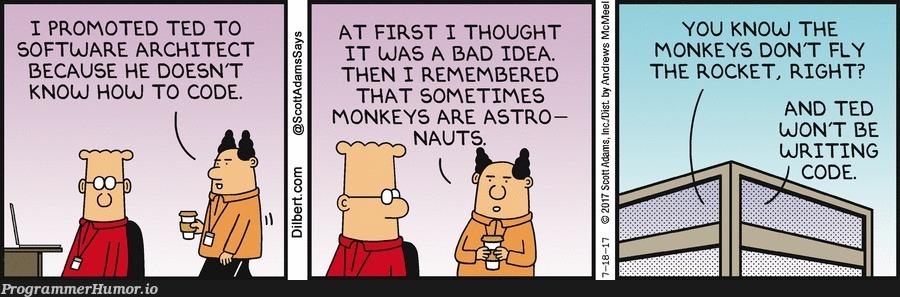
For that matter, you can also encounter quite a lot of "the architects don't know how to code"* stereotypes, so the subtle-disdain thing can go both ways (your comment may be exemplary). I try to prove them wrong by having written more and more different stuff than most :-)
I think sometimes if there's a project that's getting highly voted up but the initial few comments are negative, the thread can stay that way.
I agree with what you said though, when I was 13(-ish) I had an XKCD store t-shirt with a bunch of Linux commands upside-down so you could reference them [1]. I loved the idea but didn't love the shirt (not a fan of black t-shirts), so I didn't wear it much. I would've definitely wore this watch though, I'd even wear it today except I recently got a chunky watch that fits my proportions better than the retro-Casio-style.
Is there any indication they are actually working on this and Altman is any good at pursuing this goal? I'm seriously asking, please inform the uninformed.
My impression is that I hear a lot more about basic research from the competing high-profile labs, while OpenAI feels focused on their established stable of products. They also had high-profile researchers leave. Does OpenAI still have a culture looking for the next breakthroughs? How does their brain trust rank?
The OSS that keeps getting "better" is one that accept lot user feature requests and/or implementation. Else maintainers are hostile to users. And when they do accept most of those requests and code we all know how it goes.
Gimp has generally been getting better and more capable for free, and hasn't launched any cloud-based subscription services, feature gates, ad-funded functionality or done price hikes like almost every one of its commercial competitors.
There's also Krita, which artists love.
That this comment keeps oscillating between upvoted and downvoted (with significant spikes in both directions) is an interesting insight into the span of opinions on HN between the hustler types who hate the idea of software that doesn't turn a quick buck, and the crafters :-)
This right here is moving me back to GrapheneOS and Linux. I was lucky enough to be able to uninstall Liquid glAss before the embargo. I will miss the power efficiency of my M1, but the trade off keep looking better and better.
being poor, I need to sell my Macbook to get money to pay of my 16e, then sell the 16e and use that money to but a Pixel 9, then probably a but a Thinkpad Carbon X1. Just saying all that to show you the lengths I am going through to boycott/battle the enshitification.
It's not talking to an LDAP server, it's the functionality for talking to an LDAP server that is causing the issue. Even if you don't need LDAP you're still vulnerable when a client can inject information in a log message.
Why is this functionality needed in the first place? I want to write log, some kind of string, into some kind of files, with rotation, maybe even send it somewhere that expect logs.
Why parse whatever is in the logs, at all?
Imagine the same stuff in your SSH client, it would parse the content before sending them over because a functionality requires it to talk to some server somewhere, it's insanity.
Log4j contains a very big collection of extensions for just about anything including inserting data from various sources.
Of course it's overkill for lots of situation, but nobody ever uses all functionality. It's just that nobody can agree on which functionality is useless ;)
Indeed a software used by thousands of commercial products and millions of enterprise applications with ZERO dollar support from either must be maintained at perfect, bug free level by lazy volunteers. Because internet demands it.
Would it even be possible to create today's software ecosystems by mandating all libraries are maintained and supported to the strictest standards?
That would be the end of open source, hobbyists and startup companies because you'd have to pay up just to have a basic C library (or hope some companies would have reasonable licensing and support fees).
Remember one of the first GNU projects was GCC because a compiler was an expensive, optional piece of software on the UNIX systems in those days.
That would be the end of the software industry. No company outside of aerospace and medical devices is capable of delivering this and I even have my doubts about those two, though at least they are trying.
It's not really added functionality, more unintended consequences of too much flexibility. Java contains JNDI (Java naming & directory interface), a very unified 'directory' system for all kinds of configuration of which LDAP is just one of the backend implementation options. The key issue is you can call into other objects which is unwise to do when used with untrusted user input.
> The key issue is you can call into other objects which is unwise to do when used with untrusted user input.
This, and while in this case it is specifically unwise on security terms, there are plenty of other example where the feature are completely cosmetic and deviates from the core user requirements/scenario.


And ASML licensed the technology from EUV LLC.
Which was a conglomerate of a bunch of state-funded US research labs.
And the US cut its science funding.
Misery all the way down!