Please change the title back to the original: "The Voyage to the End of Ice"
The article is clear in stating that prediction is difficult and ranges from 10 years to 200. Putting the lower end of that claim in the title is clickbait-y
An artistic title can work in media rich publication, but in an aggregator like HN you need something descriptive of what the article actually is (although I tend to just keep the original title if it fits in the length limits)
Maybe something like "How soon can we expect Summer Sea Ice to end?"
Alright, I take my comment back. I checked in National Geographic. If we don’t make drastic changes, summer sea ice is projected to end after 2060 [1], although it is always possible that things spiral out of control in unexpected ways.
You could invest into transportation firms along traditional land/sea shipping routes, assuming the market has priced an expectation of the Northwest Passage opening up and ruining business into those firms' valuations.
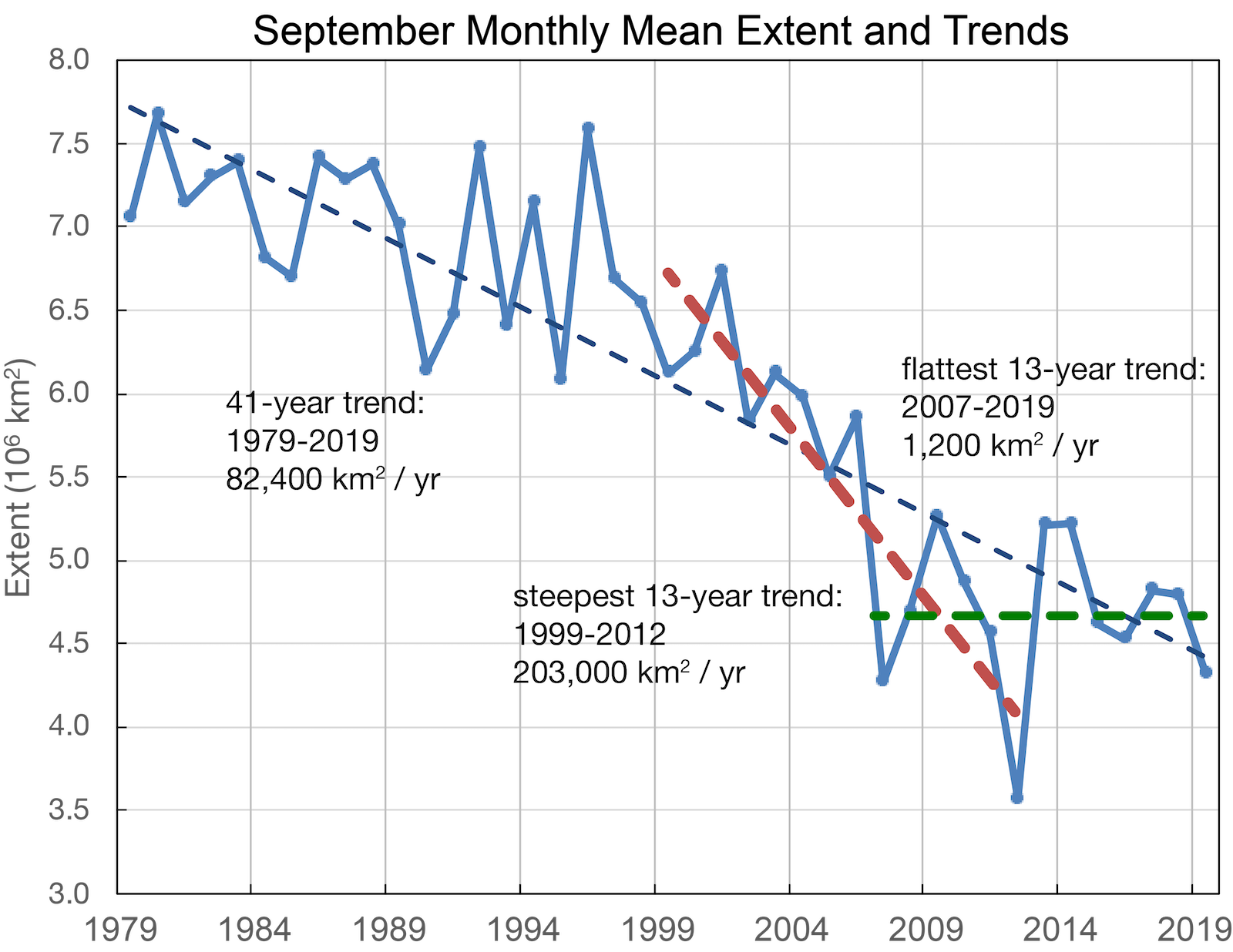
The long term trend is decrease of 12.9% per decade. The steepest decline over 13 years is 1999 to 2012. There has been little decline over the 13 years 2007 to 2019.
This is a problem of science journalism. We don't want all scientists' predictions to agree - there should be a range that reflects the real uncertainty. But combine this with the demand for big headlines, and you have a broken way of conveying predictions to the public.
I think so too. But why don't we ever hear the scientific community come out and stand up for themselves? I imagine that would be considered news in and of itself.
I reckon its because there is a social and possible economic price to pay to say anything that detracts from a sense of emergency around the climate. It is a toxic culture now similar to that of the 'woke' wing of the left or the pro-gun wing of the right.
If anyone wants the general public to take this issue as seriously as it should be FUD is not the way to go. I think it hurts more than it helps.
If scientists knew how to fix science journalism, we would. It's not just climate. Cancer research and diet research have the same problem, and if battery capacity had doubled for every headline saying it had, we would be charging our phones once a year. But the science journalists argue that they're not lying, just picking the most interesting stories, and that otherwise no one would read them at all. If scientists came out with a statement that science journalism is a fraud, it might be sensational enough to make the news, but it wouldn't be true. If they said science journalism needs reform - well, I'm sure you can find plenty of blog posts arguing this, but not a lot of media coverage.
> If scientists came out with a statement that science journalism is a fraud, it might be sensational enough to make the news, but it wouldn't be true.
You're arguing the extremes here. Scientific organizations could easily publicize their displeasure with how their work is communicated to the public without calling the media fraudsters. Give me a break.
If you see smart people not doing something they could easily do, maybe it's not so easy? Example: the American Council on Science and Health put together a ranking of science journalism sources, putting Nature at the top, and Nature responded telling them they weren't helping.
I admit I'm speculating a bit when I try to explain why reforming science journalism is difficult, but I'm pretty sure empirically that it is difficult.
The climate is a non-linear dynamic system. Even if you had the perfect computer model to represent the earth's climate system, if your input parameters were off by even the slightest bit you'd be way off base in 5, 10, 50 years. That's why weather predictions are useless more than 10 days out and why we can't predict hurricane movement more than a couple of days out and our uncertainty increases as a function of time. This stuff is way more nuanced and complex than anyone lets on. You can't even begin to explain it in a one part article...and meanwhile, fearful headlines remain top click targets.
Since 2007 a handful more of sea ice observing satellites has been launched into orbit, hundreds if not thousands papers about sea ice have been published and sea ice models have been improved significantly - all telling the same thing: sea ice decline is happening.
It's a good thing science makes progress every day, just start listening.
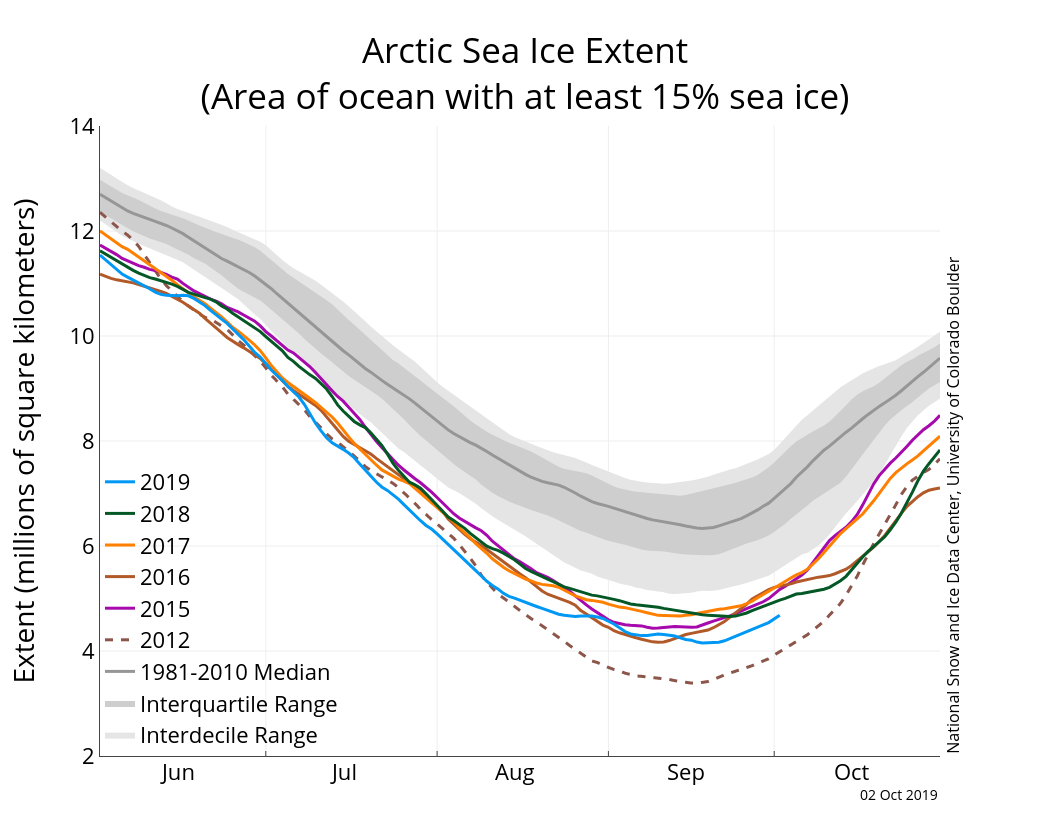
If observing just the plot of "each September in each year" one still misses the whole picture which is (all extents through the time, not only Septembers:
Specifically, 2012 was such an extreme year that the following years seldom compete with it, but they still do, and the trend to decrease is still obvious.
2012 wasn't bad measurement, it was actually visible from space. Also, cyclones in the Arctic is nothing special, 2012 was hefty, because the ice was already very thin and the ocean absorbed a lot of heat.
I didn't say it was. I said it was an outlier.
Cyclones in the summer are rare.
It was also a major reason that the sea ice extent got as low as it did, and it's never got even close to that low again. It's not relevant to the long term or short term trend.
Weird cause all the models I’ve seen show basically a balance and no real change. Arctic losing more ice but Antarctica adding more sea ice such that it’s basically a wash.
For what it's worth, here in Denmark, no snow whatsoever this year. Temperatures have been in the 6-7°C range, which is really weird, since it's usually below zero these months.
"At this rate, the Arctic Ocean could be nearly ice-free at the end of the summer by 2012, much faster than previous predictions."
I'm not sure why you read this as a prediction. The article mentions how this statement was made in 2007, a year that saw "record melt all over the Arctic." This fact probably accounts for the "at this rate" qualifier used above. The phrase "nearly ice-free" is also not the same as "no ice."
==I am not saying climate change isn't happening but predictions like this are not useful.==
Maybe it is more about how you frame things in your mind. In this case, you inferred a prediction and used that to discredit the scientific data.
He says, if the rate from 2007 holds up, the melt will happen faster than others predicted. He is not predicting that it will hold up or saying outright that the ice will melt by 2012. The rate from 2007 didn't hold up, which invalidates the rest of the comment.
Either way, you still manage to ignore the phrase "could be nearly ice-free", as that discredits your entire assumption that he predicted it would be ice-free in 2012.
Statements like "could be nearly ice-free" are milk toast and meaninglessness. It is plan and simple CYA. It provides an out if the predictions don't turn out they way they expect or desire.
This is the whole tactic. Shift the argument to one about semantics (and articles from 13 years ago), meanwhile ignoring the mountains of scientific evidence we have today.
from the politifact article - "A fair statement would be that some scientists have predicted summer ice free Arctic Ocean as soon as 2013, but others expect it to happen a little slower — say 2040-2060," Schmidt wrote.


The article is clear in stating that prediction is difficult and ranges from 10 years to 200. Putting the lower end of that claim in the title is clickbait-y