More important, in the nearly hundred and fifty years it has taken for the church to assume its final form, Gaudí’s once revolutionary aesthetic no longer looks futuristic. Early critics of the Sagrada Família accused Gaudí of being too over the top, but his commitment to visual abundance has become a universal aspect of pop culture—think of the ornate C.G.I. cityscapes in “Black Panther” or the “Star Wars” films.
I was never into architecture and am not a religious person but visiting the Sagrada Familia was profound. I came out a slightly different man than one who walked into it just half an hour before. No CGI hack comes close.
I'm Christian, so slightly different context going in, but I also found it profound. I've been to other churches and cathedrals (including the Vatican!) and they feel sterile by comparison. Stepping inside to the sight of a towering forest of stone and dazzling light is truly breathtaking. It made me genuinely emotional.
It's nothing like I've ever seen before so I'm surprised by the comments at the end of the article that make it seem like its originality has waned over the years. You can feel the conviction and passion that have been poured into it for over a century.
Our guide showed us on his phone pictures how the colors change in different months.
I never thought about how I would build a church to exemplify Gods creation, but after that I wondered about cathedrals out of glass or crystal. I must have raved like a mad man about the Sagrada to my friends who had chosen to stay in the hostel!
It made me appreciate cathedrals more. Like now they are are old and ancient, but imagine living in a medieval village and making a once-in-a-lifetime pilgrimage to a big city and being dumb struck about the tallest building you have ever seen and architecture which is familiar but you could have never dreamed up.
As someone who has loved sagrada familia since I went in, I think the experience of Sainte Chapelle is my second favorite (go first thing when it opens to have it to yourself) and is more underrated than sagrada familia^
Related/unrelated, part of my joy in the sagrada familia is that being a tourist feels essentially the same as being a pilgrim. If you get a chance to visit parc guell, you aren't exactly experiencing it as a park, but as a tour through the different ideas in the park. (Compare this with an unguided stroll through Central Park, where you and all of the other visitors are likely experiencing it as a park (the way it was intended)
^ I think! In my experience it's occasionally overlooked in a short trip to Paris, whereas if you're going to just see one Gaudi, make it the cathedral
If you’re not familiar with Gaudi’s life I think you’ll find it equally inspiring. He was extremely successful and heavily communist (He was always Christian for all that some think you need to be atheist to be communist), and ended his life living a functionally monastic life dedicated to this project, literally living in the crypt.
I went there over thirty years ago when it was still easy to just walk in without booking or being part of a tour.
One thing that impressed me about it was its effect on others. There were lots of Japanese tourists there at the time. I climbed the stairs up one of the towers with a Japanese man festooned with cameras as usual, I had my SLR with me too. When we got to the top we sat in silence looking out onto the church with it's unfinished roof, neither of us took a single picture. I think both of us were first overwhelmed and then we realized that no picture would capture what we saw and felt. I did take a few pictures of the spiral stairs on the way down, just to have a souvenir of the place.
When I got to the bottom I shovelled all my Spanish coins and notes in the donation box. Perhaps they bought a few kilos of cement with it, I like to think that I helped in an infinitesimally small way to build it.
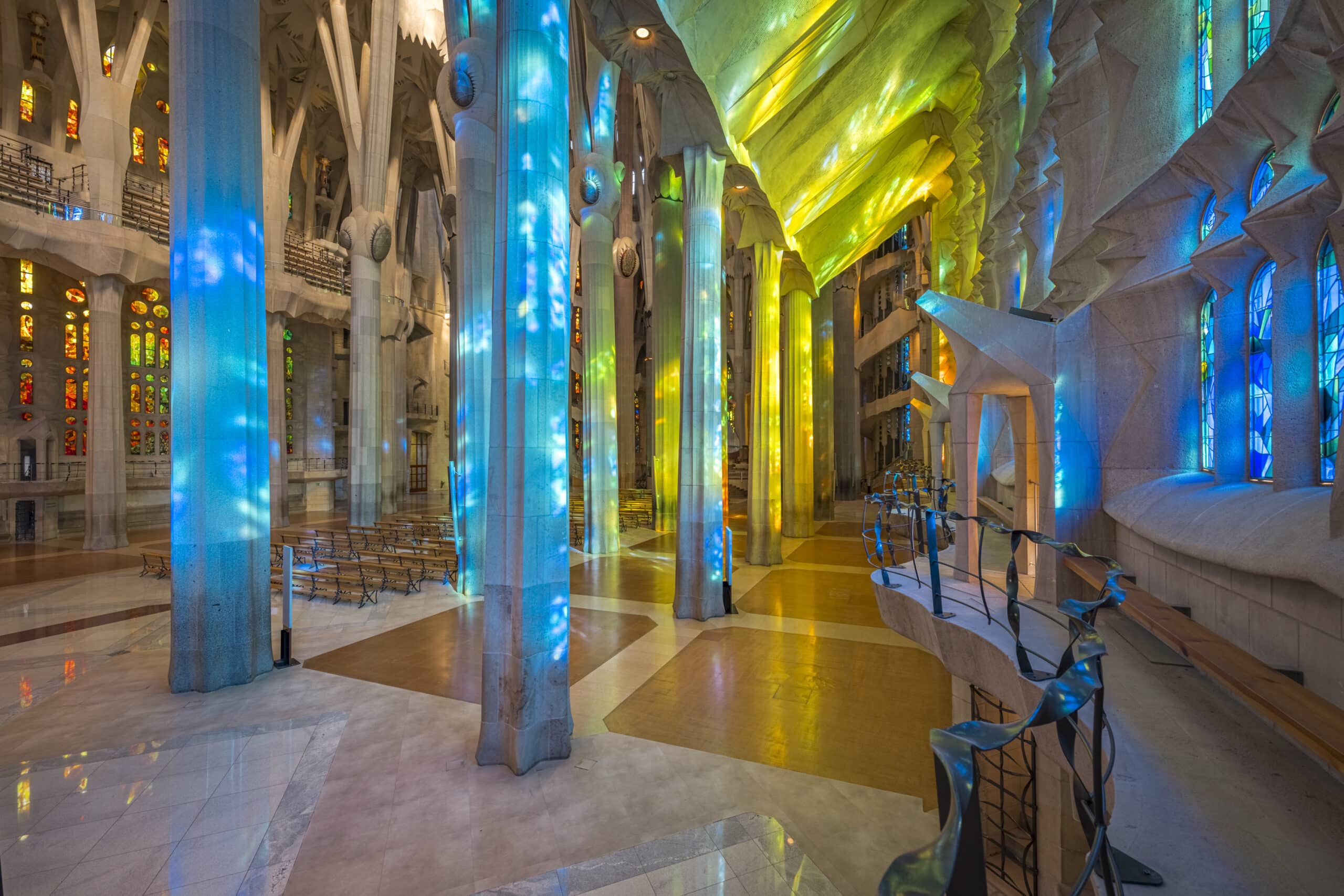
Same here. It was an amazing experience. I was lucky on my visit day and time that it was sunny and the sun was setting down which made spectacles of light show inside. I just stood in the middle for half an hour amazed.
I've been twice, and unfortunately it was cloudy on my second trip.
The difference light quality makes to the experience is remarkable, and I implore anyone that visits to ensure you go at the right times on a clear sunny day.
You may think you've seen well lit stained glass before, but it's like freaking lazer beams of thick light penetrating the environment to the point where it doesn't seem natural.
I’m doing a nerdy Catholic project that calls for attending Mass at churches all over Chicago (https://www.dahosek.com/category/catholic-nerd-pilgrimage/) and one recent church had an east-facing wall that was entirely stained glass that was quite a dramatic effect during a morning Mass. The right combination of architecture, geography and weather can do some amazing things.
When the commission is to create the most impressive structure possible, anything less would be a failure. That is just how the Catholic church rolls. See most European art and culture for the last 1500 years for details.
The Cologne cathedral took over 600 years to finish because the original plans got lost along the way. it was paused after 300 years! For the following centuries, many generations only saw the same unfinished state with the crane on top.
Most cathedrals and monuments are like that because until recently in human history, they took a long time to build and so the original architect would die, the financing might collapse, etc. Heck, this happened to Gaudi; the remarkable thing here is that the people after Gaudi wanted to continue his vision as much as they could.
The Washington Monument in DC, for example, famously is different colors because they had to change the source of marble during construction when funding halted for a time.
Fiction, but you if wonder about things like this, you might be interested in The Pillars Of The Earth series about the building of a cathedral in 12th century England.
Not sure “celebrities” were such a thing as they are today. 7 centuries was before the reformation and things were pretty austere. Surely nobles celebrated things and there were favored artisans but celebrated as crassly as we do today in such abundance. I don’t think the media existed to allow that to take place.
Eh, they certainly weren't celebrities in the same way, that would only be possible with modern broadcast media. But people like the pope, kings, and dukes would be pretty close. I would expect the average medieval peasant would know who the pope (or popes, depending on the date) were, and at the least who their king was, as well as the relevant nobles for their village. And I wouldn't be surprised if they knew who the neighboring kings and nobles were. A peasant from the Iberian peninsula might not know who the king of Poland was, but they would likely know who the French king was and likely who was emperor of the Holy Roman Empire.
And medieval people definitely built monuments to themselves. A great example is Battle Abbey [0]. The official reason it was built was as penance for William the conqueror killing so many English, but there is definitely a strong case to be made that building such a grand abbey was in 0art to signify the new Norman rule and to remind people of who was in charge. They weren't venerating the architect, but it was very clear to everyone who paid for the abbey and William remained very much linked to the structure. That would have been one of the most impressive buildings for a very large area, even it's ruins remain impressive nearly a millennium later. It's a religious building, but it was even at the time very much linked to a secular ruler (inasmuch as the rulers of the time were secular).
It really depends on what you mean with "know" here.
The legend say that when the king tried to flee the revolution he was only recognized due to a coin with its face engraved in it. A teacher taught me this one with a variant where the king itself gave the coin to pay in a tavern. Now even it is just a legend, that also gives an interesting reflection on what it means to be famous at this time.
A typical Iberian peasant probably wouldn't have heard of Poland. The King or Emperor would be "the King" or "the Emperor" and might as well live on the Moon.
Not many people realise that the more distant locations in Shakespeare's plays were close to science fiction. If you were a British peasant visiting "Verona" or "Venice" was like visiting the ISS. You might get swept up to fight in France, and there was a tiny chance of joining the navy. But most people spent most of their lives within a tiny area, with little idea of what was happening elsewhere.
So cathedrals were stunning. If you somehow visited a cathedral city you'd be struck dumb by the size - unimaginable to someone who grew up on a small holding.
> The construction of the cathedral, which had started in the year 1015 and had been relaunched in 1190, was finished in 1439
"finished" is arguable because it still misses one spire ;) but that's now part of its character.
> Standing in the centre of the Place de la Cathédrale, at 142 metres (466 feet), Strasbourg Cathedral was the world's tallest building from 1647 to 1874 (227 years) [..] Today it is the sixth-tallest church in the world and the tallest extant structure built entirely in the Middle Ages.
From clair-obscur lighting inside to outside horror vacui vs a clean and geometric interior, it is a cathedral of contrast, whose architecture is not just a thing in itself but also extends to the area it is sat in, e.g the streets around and the plaza channel the "devil's wind", a nearly constant airflow running around the exterior that symbolically cannot enter the cathedral, which gives an immediate impression of calm as you enter.
It also houses since 1352 an astronomical clock reminiscent of the Antikhytera mechanism, and notable for having a Copernician (heliocentric) orrery since 1547; the confluence of science and clergy is yet another contrast.
Surrounding - and generally in the whole city - buildings are tall-ish but much less than Barcelona, making the Strasbourg Cathedral absolutely towering, whether you stand in front of it or from dozens of miles away.
"I like to see a man standing at the foot of a skyscraper. It makes him no bigger than an ant... The God-damn fools! It's man who made it—the whole incredible mass of stone and steel. It doesn't dwarf him, it makes him greater than the structure. It reveals his true dimensions to the world. What we love about these buildings, Dominique, is the creative faculty, the heroic in man"
It really is an amazing building can sit beside all the gothic cathedrals in terms of beauty.
I had a similar experience. The "Sanctus Sanctus Sanctus" written in stone was not an aspiration or a motto for me when I visited, it was a statement of fact.
> On a perfect September afternoon, I walked alone to find the church.
> One moment, only trees. The next, La Sagrada Familia.
> To stand there, before the century of brilliance and determination that combined to create this mass of stone and glass, on the edge between nature and society, and see, and sense that I too am seen, was one of the great privileges of my life.
You have to be lucky to get a sunny day though. Of course it's Barcelona so that's pretty likely. But on a sunny day the colours are much deeper. The best lighting you get near the end of the day when the sun is low and shines the colours right across the whole church. It's an amazing kaleidoscope.
> The best lighting you get near the end of the day when the sun is low and shines the colours right across the whole church. It's an amazing kaleidoscope.


I was never into architecture and am not a religious person but visiting the Sagrada Familia was profound. I came out a slightly different man than one who walked into it just half an hour before. No CGI hack comes close.