> I was only talking about the US. I am not familiar with European problems,
You're not familiar with US realities either, but nonetheless my original comment was about the whole West (which has faced the same neoliberal switch, in roughly the same time frame, with roughly the same social consequences even though the details differ a bit).
> Then, Detroit in fact has a massive number of abandoned houses, so yes prices did effectively go to zero. Presumably if they could be sold to anyone they would be, but they are not worth owning https://detroitmi.gov/news/deputy-mayor-detroit-land-bank-au...
> Thanks for providing me with this great argument for supply and demand, I will use it in future ;)
This is a fascinating way of misconstruing the reality to fit in your ideological views.
People did not stop paying rents in Detroit during the period, the effective cost of housing never reached zero, in fact people were still spending 30% of their income in housing[1] despite the houses themselves being practically worthless. That's a great example of market failure, because the market price kept hovering way above the actual market value of the goods (which is what they ended up abandoned in the first place, they were never on sale for $100 each or even $10k, they were just kept empty until they got destroyed due to lack of maintenance).
Yet you still find a way to twist that evidence into a confirmation of your beliefs.
This is genuinely fascinating. The only comparable thing I've seen is this: https://www.youtube.com/watch?v=SrGgxAK9Z5A (though in fairness the guy seems to have quite a bit more self-awareness than you do).
You can literally open the page I sent you and they are selling vacant lots to neighbors for 100 dollars. They have also done thousands of demolitions of the houses that nobody would have at any price. The reason they were not sold is not because of market failure, it is because there was no viable buyer. With property taxes and maintenance obligationss their market price was negative. The government had to issue bonds to tear them down. That means, procedural constraints aside, you could go and have the house for nothing. The market price of a marginal house in Detroit is/was recently below 0. Supply and demand. Of course, just like when your house price goes up you don't get charged extra money, when your house price goes down nobody undoes your mortgage, so people keep paying. But for a new buyer, your only cost after a nominal fee would be properly taxes and maintenance/utilities, those are hard to blame on neoliberal turn.
I think it is you who is suffering from ideological blindness, especially since you keep changing and confusing your timelines and definitions.
I sent you BLS data on housing as percentage of income for the entire 20th century. And census data on median house size. Spending on housing went up from 29 to 32 percent from 1960 to 2000, more than offset by other essentials in the same paper and for much more house. When was that mythical impact of the neoliberal turn? Last time we were talking about taxing the rich or whatever, I sent you the flat-ish 1% tax burden data since 1979, you didn't like it as it didn't have earlier data. Was the negative impact from the neoliberal turn before 1979, or after 2000? Is it in the room with us right now? ;)
EDIT as for US or not; I accidentally erased part of the comment when editing. Would you agree that US is more neoliberal than Europe when you talk about neoliberal turn? If so the impacts of neoliberal turn should be larger, and it should be sufficient to discuss the US. In other cases, since I dunno much about Europe other than high level, I cannot comment on their unique neoliberal negatives. Perhaps those are bad and they should do what US did instead.
> You can literally open the page I sent you and they are selling vacant lots to neighbors for 100 dollars.
The they does the heavy lifting here: it's the city council that does sell that for this price. And it had to intervene because the private market never reached its own equilibrium.
> They have also done thousands of demolitions of the houses that nobody would have at any price. The reason they were not sold is not because of market failure, it is because there was no viable buyer. With property taxes and maintenance obligationss their market price was negative.
The market value was negative, but the market price never was.
> The market price of a marginal house in Detroit is/was recently below 0. Supply and demand.
Yet people of Detroit kept spending 30% of their income in housing, and you don't see the paradox.
> I sent you BLS data on housing as percentage of income for the entire 20th century. And census data on median house size. Spending on housing went up from 29 to 32 percent from 1960 to 2000
Which is still a 10% increase, and again we're talking about a topic for which the US compares favorably to the rest of the West. If you take housing + healthcare as I mentioned at the beginning (and I could have mentioned education as well) then the US is indeed in the same situation as the greater Western world.
> more than offset by other essentials in the same paper and for much more house
A house twice as big and twice as expensive is still twice as expensive. (And it's also twice as remote from work areas…)
> Last time we were talking about taxing the rich or whatever, I sent you the flat-ish 1% tax burden data since 1979, you didn't like it as it didn't have earlier data.
You sent me data from 1986 onwards so yeah it falls a bit short on context, and even there your data contradicts your point as I noticed (and you just avoided the question to move on another subject).
> Is it in the room with us right now? ;)
You are part of the negative impact of the neoliberal turn actually, with markets becoming a religion symmetrical to Marxism and the in-between being called “collectivism” and put in the “far-left” basket.
> . Would you agree that US is more neoliberal than Europe when you talk about neoliberal turn?
Is the sea bluer than the sky? It doesn't make sense to say one country is “more neoliberal”, the policies adopted vary a lot between countries depending on internal political balance. For instance the UK still has the NHS despite the turn but has dismantled its standing army to reduce government spendings, when the US is still spending relatively close to cold war level in its military spendings.
> In other cases, since I dunno much about Europe other than high level
That's why you should read more!
>>I cannot comment on their unique neoliberal negatives. Perhaps those are bad and they should do what US did instead.
No country can do the same exact policies as its neighbors for multiple reasons (internal politics, culture, economic structures) and no country in Europe could have had the Silicon Valley for instance. But I don't think any European country envy the US right now (they have silicon valley envy, but that's it).
Exactly! Council took the houses/lots, in some cases cleaned them up, and after that the price is $100. What do you think it was before? The same local government, that assessed some intact houses with mortgages still being paid at $5k, might give you a hint...
Detroit in particular had a large number of non-mortgage, tax delinquencies - why didn't owners choose to sell at market "value" and instead walked away? Either they were all dastardly neoliberals trying to lose money but spite Detroit, or perhaps the market value was negative so there was no viable buyer? I guess it's technically somewhat of a "market failure" that it's cheaper to walk away than to pay someone to take the house off your hands (negative price). The reason is non-market though, it's more like, there are no debtors prisons anymore so nobody can force you to pay local taxes.
Regardless you made a specific statement - if supply/demand worked, price of the houses in Detroit would have gone to zero. And, sure enough, it has in fact gone to near zero, and factually below zero given house has additional (non-market) negative cash flows.
The rest:
"Which is still a 10% increase" "A house twice as big and twice as expensive is still twice as expensive." Hmm?
What about the house that is 10% more expensive over time but x1.5-2 bigger?
Also why is it that /median/ houses are x1.5-2 bigger (while the household size is decreasing, too), is it dastardly developers intentionally trying to screw affordability, or is it because a /median/ household wants and can afford a bigger house cause the median household is more rich?
For healthcare I already sent a link above. The closest correlate of healthcare spending across countries and over time is disposable income. You can spend millions of dollars to keep grandma alive for an extra 6 months, which is, apparently, what rich people do (e.g. https://mdinteractive.com/mips_cost_measures/2025-mips-cost-...). Could we spend it better? Probably. I think free market with insurance that works like actual insurance (like existing cancer insurance) would be better, but let's do medicare for all, sure, it's not going to be much worse than current system. But spend it we will, until we become poor.
For taxes, I sent you a data since 1979 after that. The data shows Reagan's reforms and later reforms had basically no effect on 1% tax burden relative to other groups.
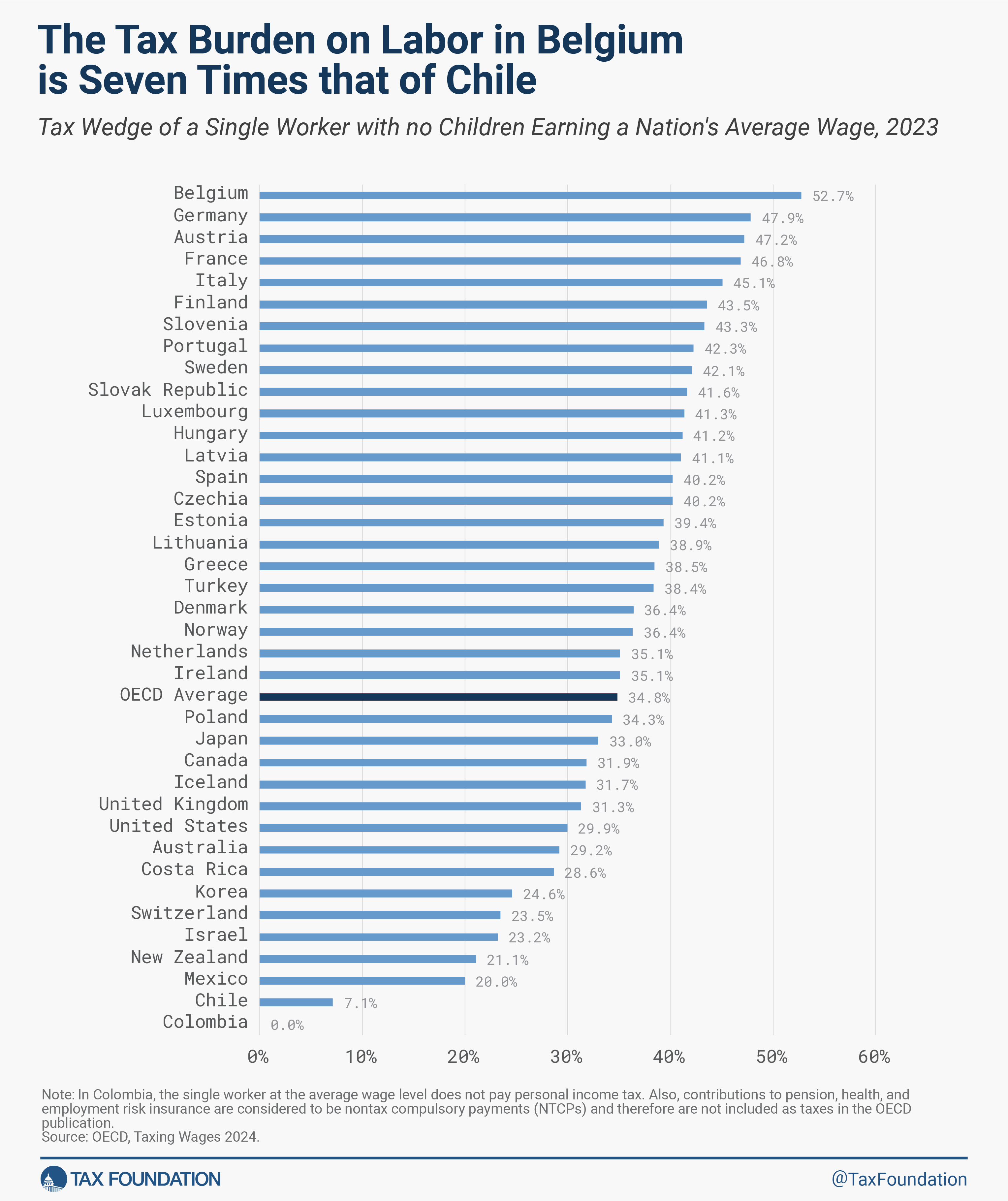
As for European issues specifically, the only reason would be to find out what policies the US should avoid, since Europe is relatively poor, but I've never thought neoliberalism is their problem. More welfare state, more taxes on workers (https://taxfoundation.org/wp-content/uploads/2024/05/OECDLab...), more regulation (in most countries), harder to build housing (in some countries like UK?). Too little neoliberalism. I don't expect to find any neoliberal policies "worse" than the US ones, so it's not worth my time, but do give a hint, maybe I will.
In the US though, the only problems with neoliberalism are either hyperlocal and affect a very small percentage of the population, or that it didn't go far enough. If neoliberal turn didn't end before, for example, reforming unsustainable welfare state to be smaller; or undoing environmental regulation; US would have been in much better shape right now, with less need for interest groups to fight over a smaller pie.
> Regardless you made a specific statement - if supply/demand worked, price of the houses in Detroit would have gone to zero. And, sure enough, it has in fact gone to near zero
It hasn't. It remained steady at 30% consumer spending.
“Why would consumers spend 30% of their income in something that is available for free on the market?” is the paradox you been avoiding all along.
The answer is simple, these “free houses” never actually went on the market because humans aren't rational and they think a house's value is at least roughly equal to the price they paid for it, which means they will refuse to sell for less, no matter if they lose money in the process. Ask any real estate agent.
Supply and demand almost never work for assets unless there's a significant liquidity pressure.
I'm not going to respond to anything else because you will again take that as an opportunity to escape the paradox. (And because it is much more entertaining than attempting to explain why allowing corporations to poison the neighborhood isn't a good idea)


You're not familiar with US realities either, but nonetheless my original comment was about the whole West (which has faced the same neoliberal switch, in roughly the same time frame, with roughly the same social consequences even though the details differ a bit).
> Then, Detroit in fact has a massive number of abandoned houses, so yes prices did effectively go to zero. Presumably if they could be sold to anyone they would be, but they are not worth owning https://detroitmi.gov/news/deputy-mayor-detroit-land-bank-au...
> Thanks for providing me with this great argument for supply and demand, I will use it in future ;)
This is a fascinating way of misconstruing the reality to fit in your ideological views.
People did not stop paying rents in Detroit during the period, the effective cost of housing never reached zero, in fact people were still spending 30% of their income in housing[1] despite the houses themselves being practically worthless. That's a great example of market failure, because the market price kept hovering way above the actual market value of the goods (which is what they ended up abandoned in the first place, they were never on sale for $100 each or even $10k, they were just kept empty until they got destroyed due to lack of maintenance).
Yet you still find a way to twist that evidence into a confirmation of your beliefs.
This is genuinely fascinating. The only comparable thing I've seen is this: https://www.youtube.com/watch?v=SrGgxAK9Z5A (though in fairness the guy seems to have quite a bit more self-awareness than you do).
[1] https://www.bls.gov/regions/midwest/news-release/2017/consum...