I’ll risk it and defend marriage to this crowd. To me getting married was about getting out of myself. As someone who got married later in life, I’d spent decades living only for myself, doing what I wanted to do when I wanted to do it. Relationships were shallow and lasted only so long as convenient. By choosing to get married and intentional build a family, I knew I was sacrificing a lot of ego and choosing to give up a lot of freedom and self. But I was ready to do it. I firmly believe what we’ve created is greater than either one of us, and is worth the irritations sacrifice.
> Relationships were shallow and lasted only so long as convenient.
I think this is a big thing, and one that in the end will ruin us as a society if we let it. There's something innately wrong about this constant rat-race I see in some friends where they effectively say "oh, there's something wrong with this partner that in my previous X relationships I didn't see before. let's go find another one".
Modern communication methods (social media and dating apps in particular) have created a situation where you can constantly compare your partner to the rest of the world, while at the same time (theoretically, for most people I'd argue partner choice hasn't increased at all, or even decreased) widening the dating pool. The idea of commitment becomes... Alien, because it's so easy to just go and trade her in for a newer/better model, not realizing that we're all flawed in our own particular way and that part of a relationship is sticking with eachother and growing because of that.
A friend once told me to be very careful, because it’s too easy to compare your current parter to the best attributes of all previous ones.
Ie she’s not as smart as Michelle and not as funny as Jane and not as considerate as Mary.
Eventually, you start looking for the absolute best in every way, which is probably never going to exist
Yup. It puts some truth in the things people say about pair bonding, even if biologically it doesn't entirely fit. The default assumption becomes under this (fairly natural) behaviour that the more partners you have had generally the less likely you will be to make a next relationship last.
You seem to be describing a committed relationship?
For me the significant markers of committed relationships were first moving in together, then perhaps buying a home together (in those places where that was still affordable), and then for those that wanted them and by far the most important having children together.
Many of my friends and family have gotten married along the way too but it never felt like a big deal because by the point they got married they'd already been together for several years. It was a nice opportunity for a celebration! But having children together seems the far greater commitment. Marriages may end but even if you split up you'll still be parents together.
I grew up in a far less religious society than the US so maybe this just reflects a different cultural background. The US has always been more religious than Europe while also having far higher rates of teen births and children living in single parent households. But US rates of religious identification and teen births have both been falling rapidly over the past couple of decades.
Extremely American way of looking at it. Here in France most of my friends have been in committed relationships and living together for years, some have children, only one couple is married. Marriage is an holdover from a time far removed which is both utterly useless and slightly paternalistic.
I think your view is an extremely Western way of looking at it. Maybe examine attitudes in India for example. Also Indonesia and many others; possibly a supermajority of people in the world, even.
> living only for myself, doing what I wanted to do when I wanted to do it.
This. And ultimately having kids with this person is another ego-exposing (and hopefully ego busting - but that's not guaranteed) exercise that contemporary societies gave up trying with varying excuses ranging "economical" to "climate saving" reasons.
Do you see a lot the argument that having kids is bad for the environment? Can I ask where? I do not disagree, I just rarely hear it, it's something people are afraid to day out loud in my social network, it's socially unacceptable, but it's changing a bit.
This is everywhere. Google something like "childfree environment" and see floods of articles and testimonials. People will also say this in person, or at least express reticence over it, but I also find that less so than I see it online or YouTube. As to what percent of people actually follow through with not having kids with this as the true primary motivation, Idk.
Very interesting. My social circles are significantly older than the women deciding not to have children – apart from Stephanie Mills, which actually did have a child. I guess time will tell if these women are being serious or if it’s just a pretext to push back on social pressure (and I 100% agree on pushing back this type of pressure).
Read HN posts on climate change. On almost every one, there will be a subthread on "don't have kids because of environmental impact" (and another one that says not to have kids because they're doomed).
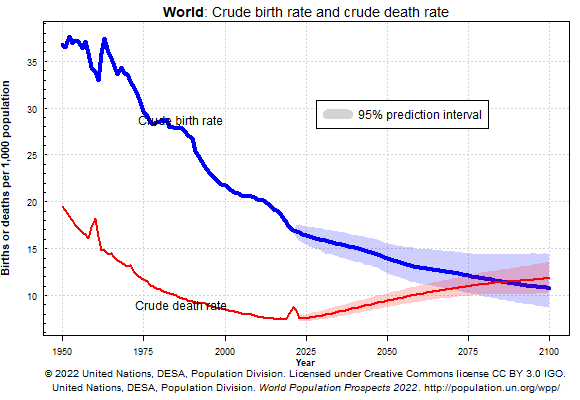
Interesting, somehow this doesn't reflect in birth rate decline. The decline has started long ago and continues roughly at the same pace, no massive acceleration [0].
My ignorant as all hell take is that this is tied to the collapse of the enforced nuclear family social construct. Women grew their careers and were able to have financial independence. As women began to have the option to choose not to have children many decided to take that approach. Once the decline really sets in it's during the wealth extraction of the middle and lower classes by Reagan and the destruction of leftist and minority family units through the War on Drugs in the '80s and starting in the '70s respectively. By the time the '90s roll around the trends are entrenched and here we are.
To hell with the nuclear family; all that was was a barely veiled attempt to maximize the consumption factor of the economic equation by seperating disparate generations in seperate homes.
It's an interesting issue as folks who want to get married, start a family, and develop that nuclear style household are presently the same folks who are not able to buy a house, afford medical bills, hell even most cannot afford a $500 emergency. Even without everyone having their own home and driving consumption, it's not likely that the situation would be all that much different.
NPR had a segment on women who chose to be child free and it was a widely cited reason. They either didn't want to bring a child into a world that would be in bad shape or felt it was selfish to bring more burden onto mother nature.
“life is futile and will inevitably lead to suffering, decay and death”. Ok, but she really is of the opinion that life in general is futile, independently of the state of our planet… I mean life has always lead to death and decay, and had always meant suffering (amonst other things), especially thousands of years ago.
Not saying what she says is meaningless, but she’s not really about saving the planet.
How much of that was making the marriage official or just committing to a long-term partner?
I know someone who was with their partner for years, and has been engaged for years more. I've come to the understanding they'll likely never actually marry. They appear to just want some negotiated commitment. Actual marriage appears to carry strings they're reluctant to accept. (Funds appear to be kept separate as well.)
I can speak to this in some degree: marriage is much more significant than a negotiated commitment for me personally.
A negotiated commitment takes a specific form (the terms of the negotiation) but a marriage defines a commitment to be committed. I've heard some folks of my generation say things like "we got divorced because we fell out of love", which sharply contrasts with my view of marriage and falls more in line with a standard committed relationship.
To me, a marriage is a commitment to consistently try to fall back in love and work through things, even at those points you might otherwise quit.
Granted, I'm a religious guy and my view on marriage is flavored from that perspective, but making the marriage official was certainly key to the commitment for me personally.
As you suggest at the end, this is very much your personal view.
My wife and I have been together for almost 20 years, but we've only been married for 2. Our commitment didn't change due to marriage. The only thing that changed was that things got easier from a legal perspective. We no longer need to worry about wills in the case that one of us dies, and we can make medical decisions on behalf of each other if necessary.
I suspect that for many people who don't have a religious desire to marry, marriage won't affect their level of commitment. I think this is supported by how often people get divorced.
> When a relationship has been proven for a decade or more, then marriage can be contemplated more realistically.
This sounds good but the data seem to contradict you[0]. It's been known for a long time that people living together are more likely to get a divorce. This study is about re-evaluating if it's still true. All in all, the person you are responding to (and maybe you?) are more likely the exception rather than the norm. But to what extent the exception? 2 years is a pretty short time frame, only time will tell.
Having known unhappily married and religious family (and leaving the faith myself), I can understand folks falling permanently out of love. And IMO they're likely better apart than locked in decades of fruitless trying.
Anyway, thanks for sharing, and I'd agree that a frivolous marriage sounds like a pointless exercise.
Falling in or out of love is really a lot of fantasy BS though really. Disney marketing. Anyone in a long term relationship doesn’t love the other all the time, wether married or not. Marriage is about declaring to your social group and each other you’ve decided to strive and commit to something greater than yourself.
> Marriage is about declaring to your social group and each other you’ve decided to strive and commit to something greater than yourself.
I think most people can accept this belief while still thinking that there ought to be an out for two people who find themselves deeply unhappy together for a long period of time. Committing to something should very rarely be an absolute thing, and most people (even those who accept and respect marriage as a social institution) don't think that marriage should be one of those things. That's compatible with thinking (as you say in your OP) that most romantic relationships are shallow and not ultimately very meaningful, and wanting something more.
It really isn't. There are all kinds of valid reasons to get divorced, from partners maturing in different directions, to one partner maturing while the other doesn't, to drug and alcohol additions, to emotional and physical abuse.
There are also selfish reasons, including boredom, finding more excitement - but not more depth - with someone else, and festering undiscussed resentment that financial and/or sexual expectations aren't being met.
If one person goes down one of those paths and refuses to even discuss it, there's not much the other person can do.
It's immature to expect a perfect glowing zero-conflict happy ever after. But it's equally immature to stay committed to something that is clearly dead and may be actively harmful to either or both partners - and perhaps the kids too, if there are any.
Yea, and as someone who's had their social group rent in half twice in recent years because of committed marriages falling apart, I'm pretty happy with less of my friends making me meet their new partner and integrate them into my life before having an acrimonious breakup after 1-5 years.
I don't care if they love each other. I care that they're not making me pick sides and often causing me to deal with people I like moving away or quitting common hobbies so they can avoid someone they've gone from loving to loathing.
I don't really understand it tbh. I was with my partner for 10 years before we got married (for a visa) and we had 2 kids by then. It never occurred to me that I wasn't committed in every sense, and having that piece of paper made no difference. I kind of think that if you feel you need that official thing then it's a signal of not really being committed or loving in the first place, but that's more of a belief I'd turn on myself than think about you or others.
When an entrepreneur or other potentially risk-taking individual gets married, I silently think "Congratulations, now if one of you craters financially, you're both ruined."
What I enjoy most is a more faithful & trusting relationship than most marriages anyway.
Also depends on how much you like having a third party(s) involved in your relationship, for some people that's all they know or prefer, others not so much. Institutions can be so much bigger than any two people so the influence can still be outsized even without marriage.
"We don't need no piece of paper from the city hall . . ."
Try putting "I'd like someone willing to sacrifice a lot of ego and choose to give up a lot of freedom and self" into Tinder and see how it goes. And as bad as the dating apps are, I never got the impression that people were evaluating each other on much more than superficial metrics in the old school dating world anyway.
In my experience, all dating is superficial in the beginning, and attempting to short-circuit that process never really works in the long run. You can't speedrun getting to know someone. This is why "dating milestones" are such a trope.
Tinder is not a place to find a spouse. Maybe some outliers can and have. But for the vast majority of people, Tinder is a place to be ignored. For a plurality of women and a minority of men, Tinder is a place to schedule hookups.
> I’d spent decades living only for myself, doing what I wanted to do when I wanted to do it
Interestingly, this is why I broke up with a fairly long term partner. I just wanted to do what I want when I wanted to do it. We didn't have any kids, so that was easy. But I lost a bunch of money from our shared house/possessions, I just let them have almost everything because I didn't care too much.
Maybe I did it in the wrong order, and if I spent decades doing what I wanted first, things would have been different. But right now, the ability to do what I want when I want is awesome and I couldn't be happier.
It's not this crowd you should be defending against - it's the profiteers. Extraction of profits has been elevated above everything else and I feel the social contract between industry and individuals has been violated. Salaries are depressed and everything is so expensive, people need to have worked-out a decent-paying career before they consider getting married and/or kids, so people are getting married later in life, or not getting married at all because the dating pool gets shallower with age.
The societal effects of over-extracting profits are ging to be catastrophic, but short-termism is now built-in.
Marriage and family and community are historically preventative of the types of exploitative individuals and groups you talk about.
In your model the causation is that profiteers caused the breakdown of marriage but we shouldn't confuse correlation with causation.
It's also plausible that the decline of marriage caused the preponderance of profiteers.
Indeed given the modern day 'profit above all else mentality' that seems to pervade many businesses thoughts these days, and the length of history of marriage, I'd say the latter is more likely.
As for dual income. I'm sorry I simply don't believe it. In my conservative Catholic circle in a high cost of living area, I'm seeing many families with almost a dozen kids where only dad is working (my wife and I included). Dad is not even a software engineer making high six figures. In many families the father's are totally normal incomes and we have a fair share of people making below average. Two incomes is a choice. There is no difference in average income between the two groups yet one has different values. One difference is the mother's are very productive amongst themselves getting things done economically.
> In many families the father's are totally normal incomes and we have a fair share of people making below average.
I'm guessing those families are not living the conspicuous-consumption that has been the "new-normal" for decades now.
I'll note that it's easier to have a single-income household when you're inheriting a house from grandma, or if dad will help with the deposit for buying a property. However, if both partners are from low-/no-wealth families, they will find themselves forced to get their career on track and/or live a more modest lifestyle than their peers.
That goes against what most people advocate as reason for women to work.
I live between Germany and Portugal, where in both countries is similar to what you describe. It is perfectly possible to raise a large family with only the father having a salary.
Today most couples have the mindset of buying a house for hundreds of thousand euros, pay tens of thousands for a car and also afford vacation to Thailand or whatever frivolous location.
Choosing a more modest location to live, buying second-hand cars without debt, having the wife cooking and taking care of the children is already a huge difference. What is not measured if the happiness of the woman in watching her children grow, that is truly fantastic. Most media favor an "empowerment" rather than presenting as option a traditional lifestyle.
Took me decades to understand this and guide my own family towards a saner lifestyle away from frivolous consuming habits.
I agree: the essential component is vulnerable commitment to something (better: someone) outside of yourself. Marriage happens to be a structure that society has evolved over time that helps people find that.
I can sacrifice my ego through meditation and acts of charity/volunteer work. No need to risk half of my current assets and future income on the whims of some potentially capricious other person, who probably doesn't like me very much anyways. Good luck to you, however.
> No need to risk half of my current assets and future income
Most people see being in a position of vulnerability with respect to another human being whom they trust as a wonderful thing, which gives them a great deal of every day happiness. You see this vulnerability as merely negative, a threat to your individualistic pursuit of wealth ("assets and income"). You have a right to live however you want, of course, but maybe consider the possibility that others are getting something valuable out of this that you've missed?
I'm certain this vulnerability does bring value to some, especially people like the original commenter. However, consider that it's possible to gain something similar in value without certain risks? My wealth is not my most important part of my life but it is valuable. Why should I risk the ability to retire, to travel as well as the security of finances, when I find so much meaning in the world already? Why do I need marriage, of all things, to another person, when I already have so much to do and see?
From my perspective, it would be if i recommended to someone that wanted money to play roulette. Sure, you may win. But the odds don't seem to be in your favor and there are more dependable ways of achieving what you want, without relying on random factors outside of your control.
However, i won't denigrate your way of living if you won't denigrate mine. On the contrary, I'm happy that some have found happiness and meaning even in such risky and perhaps old-fashioned ways.
The risk of marriage is what makes the commitment meaningful. Of course, you can always substitute for marriage with other forms of commitment in partnerships, marriage is just a particular choice.
In your writing, however, it rather appears to me that you do not see the value in committing to another person at all - in whatever shape or form.
In that case, I would say that the desire for marriage is likely to remain an enigma to you.
In rational terms, consider marriage (or another form of commitment) as a dynamic non cooperative game where a long term mutually beneficial equilibrium is reached.
Briefly, imagine you meet another person to whom you actually want to commit to: you derive utility from demonstrating vulnerability under risk.
This is the case, because the other person similarly commits to you. This mutual equilibrium is only possible with mutual trust. In turn, trust in the other person grows with mutual commitment. Trust is the driver of non ego behavior, shared understanding, and sensemaking. For evolutionary reasons, it also leads to a feeling of safety and reduces the impact of many day to day stressors. Of course, trust is only built up if the demonstrated commitment occurs under real risk and increases then over time, where the initial jump however determines largely the final equilibrium.
The equilibrium is high utility not only due to the feeling of safety and partnership, but also because a high trust environment removes transaction costs.
In turn, commitment is higher in value if the choice to deviate is meaningful, if the risk is real, if your money and income aren’t safe. If you jumped, and your partner equally jumped, both without knowing with certainty. Thus demonstrated commitment leads to a higher utility equilibrium as outlined above.
I hope this game theoretic analysis indicates to you some benefits of something like marriage.
Having lived both extremely independently and married, I strongly believe that my marriage equilibrium is far superior.
I also know that trying to get the same benefits without commitment, that is, without taking an inherent risk on another person, would not lead to the same outcome.
After all, without risk, its not really meaningful.
While marriage is just one form, I strongly believe to know that today’s culture of risk aversion in partnership leads to lower utility and long term happiness.
People are afraid to lose or give anything up.
In turn, they will gain less.
I acknowledge fully that I would not have understood the above before my marriage.
> In your writing, however, it rather appears to me that you do not see the value in committing to another person at all - in whatever shape or form. In that case, I would say that the desire for marriage is likely to remain an enigma to you.
No I think his problem is putting his assets on the line in order to have a commitment to which he think is ridiculous when he could just simply, ya know, commit.
> No I think his problem is putting his assets on the line in order to have a commitment to which he think is ridiculous when he could just simply, ya know, commit.
How does the other party know if the claim of committing is genuine or a lie? The sacrifice is the signaling mechanism.
It is like celebrating with a “high value” food or drink. Something that took time and effort to prepare, or cost a lot. Practically, you can share a meal from Chipotle and still obtain your calories, but the point of the exercise was not the meal, but the sacrifice.
Similarly, you can text someone “congrats” or you can sacrifice your time to go to their wedding. And on the other side, the couple can sign the documents at city hall, and text everyone a picture of it, or they can sacrifice and have a ceremony they invite people to.
People put their time, hearts, and lives on the line when they commit to another person. The risk of losing some money is a pretty tertiary one. I'm not saying it's negligible, I'm saying that the idea that you can just do away with risk in a committed relationship is pretty silly. I guess for some people the financial risk is primary, but that attitude seems to me ... I don't know, sad? If you really worry about it that much, sign a pre-nuptial agreement and move on.
>but maybe consider the possibility that others are getting something valuable out of this that you've missed?
Of course some people are getting something valuable. Marriage works out great for some people, and of course those people are happy to tell the world how great marriage is because it worked out so well for them.
For other people, however, it's a complete disaster.
Basically, marriage is a huge gamble. The odds are better than going to the casino, but not by that much. If you win, great, but there's a huge potential to lose, big. There's a reason the divorce rate is so high, and more recently why more people just aren't getting married in the first place. People try the "dating" process to attempt to mitigate the huge risk that comes with marriage, in an attempt to "vet" the other person before making such a huge commitment, but there's countless cases of people spending significant time dating someone before marriage, only to wind up getting divorced after a few years anyway, so clearly 1-2 years isn't really enough time to get to know someone well enough to determine if the relationship will work out, and people just don't live long enough (and more importantly, women aren't fertile long enough) for couples to spend 10-20 years dating before marriage and kids.
> If you win, great, but there's a huge potential to lose, big. There's a reason the divorce rate is so high
Divorce isn't the same thing as "losing big". The latter is a relatively rare occurrence, which can happen when the relationship is very one-sided (one spouse makes 10x the income of the other spouse), and one spouse is extremely mean and vindictive. Plenty of couples separate amicably. Plenty of couples separate and it's a long painful affair, but no one gets robbed or cheated in the process. If you really find yourself that worried about your wealth and find yourself that worried about getting cheated in a divorce, sign a pre-nuptial agreement. Most reasonable people will accept one.
My point, moreover, is that the risk itself, the state of vulnerability, is something a lot of people want in a romantic relationship. People like you and the OP of the post I replied to see this risk as pure downside. You think that everyone sees the risk this way, and that they only accept it because they think the potential winnings are worth it. Marriage, as you put it, is a huge gamble. But this is not the way everyone sees marriage. Achieving this level of intimacy with a person, where you inevitably have to trust them like this, is itself the goal. This is the "something valuable" I refer to. It means the downside (potentially getting robbed in divorce court) is offset not just by the upside (a good marriage) but also by the inherent value of the risk-taking behavior that marriage involves.
> 1-2 years isn't really enough time to get to know someone well enough to determine if the relationship will work out
Sure! I can agree with that (with the above note that getting divorced is not really the end of the world). So take 4 or 5 years. Live together for a while. Get a shared bank account when you feel you're ready for that and need to pay some bills together. You may even find that you achieve the kind of intimacy you're looking for without going up to an altar and putting a ring on their finger. I've been with my partner for over a decade, and we're not "married". I'm not old fashioned, and this isn't the 1950s anymore. But I am attached to the rather romantic notion that intimacy is inherently valuable, and that it inherently involves taking a risk.
The downside, in America at least, is not just losing some of your wealth. It's becoming truly impoverished and becoming homeless. Remember, America is a country where you can easily go from solidly middle-class to utterly bankrupt because of one medical problem. The stakes couldn't be much higher, unless they institute a death penalty for divorcing.
>I've been with my partner for over a decade, and we're not "married".
That kind of long-term trial isn't feasible once you're past your 20s, if you (or the woman) wants to have kids.
Sure, why not? Trying to get inside the head of someone you don't understand or disagree with is always a valuable exercise. There's a whole movie (Trainspotting) trying to understand why people do hard drugs. People do all sorts of stupid things, but not always for reasons you or I are incapable of understanding.
>No need to risk half of my current assets and future income
life is risk. marriage is a great way to de-risk many aspects of your life. 2x income for only 1.3x increased expenses. Easier debt/mortgage access. Support (financial/emotional) in case of illness or income loss.
>other person, who probably doesn't like me very much anyways
Marrying the right person is the key (hanging out with your best friend forever is cool), and that for sure is risky/not easy.
>marriage is a great way to de-risk many aspects of your life. 2x income for only 1.3x increased expenses
Then what happens when you get married, and your spouse soon quits their job or is fired because they're a terrible employee, and you didn't see signs of this while dating? Now you have 1.3x expenses on 1x income. Worse, what if your spouse is terrible at money management? Now you have 2-3x expenses on 1-2x income.
>Support (financial/emotional) in case of illness or income loss.
What if your spouse only seemed to be emotionally supportive before you got married, but afterwards (or when you got sick) the facade was dropped? What if they drop you like a rock when you get sick?
>Marrying the right person is the key
Of course. Similarly, if someone loses the lottery, you can just tell them, "that's your own fault: you should have picked the winning ticket".
we don't live in the 50s any more. My wife and I were living together for 8 years before we got married. That sure would have been one doozy of a long con if she turned around and suddenly became a totally different person once the ink dried on the marriage certificate.
Picking the right person is not the same as buying a lottery ticket, lol.
Now you are moving the goal posts. There are many valid reasons to get married that do not involve having children. There you can take your time.
Honestly, if you want to have children, have them with someone you can see yourself co-parenting with, not someone you love. Children place a lot of stress on a marriage, and even if you are personally compatible but have different attitudes on child-rearing it will ruin the relationship. Having kids within a romantic relationship is a terrible idea, IMHO. Be practical about it.
So many what if's in life. What if I'm successful, what if I'm a failure? Will my partner still love me? What if I'm ugly, what if my health problems are too much? What if what if... What if I divorce and lose everything? So what? You could have lost everything a thousand other ways too. A car crash, a violent attack, a random event or calculated one.
Too much success can easily lead to failure, too much failure could actually lead to success if you learn..
Life is about up's and down's, I've lost so much over and over through bad circumstances (complicated deaths, parents with problems, etc) I find it mind boggling how much control people actually think they have in life. Sometimes you just get bad hands but that can be good sometimes as it can give you perspectives that others may miss out on. Empathy is something often hard earned.
So many people think if they just play life safe they will always be safe, and yeah I guess maybe. But for me, I see life has a best hope situation in general. Get lucky and good stuff might happen to you, Do your best to get lucky. I'm so used to instability in life, I personally find it amazing to realize how many people are in a blessed position to make/have friends, health, wealth and education, a happy family and such. And I'm sure so many would see my life as stable lol.
I think the best thing is to be thankful for everything you get because it might not last but is something worse because it doesn't last or is it better? A hot piece of bread is much better then one always cold because it's so short lived and a simple pleasure. Like life itself is short lived but I've been thankful for those things I've learned.
Even if bad stuff happens it's not the end of the world, because you are still alive. Though I know plenty wish that weren't alive, some being successful at getting their wish. It's understandable, a lot of life is painful and disappointing. I'm not married or anything but I can tell you from my own experience money is a tool sometimes you will have it, sometimes you won't but you can make do, health is a blessing sometimes you will have it, but when you don't you wish so much you did, friends are such a joy when you have them but they too might not last forever, family can be the same. When it comes to love, it's really a question of sacrifice. If you love someone sacrifice is much much easier.
But I think it's hard for people to truly love. It's often painful and sometimes the rewards don't seem there. How much is their life really worth? But would you really leave people worse off? I think the movie A Wonderful Life is a good example of this. I think knowing people from other cultures and countries also makes you realize how wildly different life can be for people too.
I do plan to get married one day and I personally believe sharing everything is important because loss is to be expected so enjoy it while you can. Though I know many would find me a fool but everyone is a fool in their own way. I don't think of marriage as winning the lottery ticket but then again I think you are quite lucky to marry in the first place because quite a lot of people may never see the opportunity ever come up. Even though my parents marriage went up in flames and they both lost everything in it, I think I've learned a lot of what not to do lol. I don't blame marriage for their self destruction only their own expectations of what to expect out of life.
It was their attempts at control that caused such a spiral.
This feels like a straw man, or straw woman, as the case may be. Why would you even consider marrying someone who probably doesn't like you very much? And why would they consider marrying you?
(He says, fresh off watching the finale of Succession.)
It's a personal judgement based on personal experience. I asked those same questions before deciding that maybe dating or marriage was not for me. However, you should make your own judgement call based off of your own experiences. Just be aware that something between 40 and 45% of first time marriages fail in North America (depending on the study).
> It's a personal judgement based on personal experience.
I'm not sure I understand what you mean. Are you saying that nobody likes you? If so, then maybe that's a "you" problem and not a "them" problem...
> I asked those same questions before deciding that maybe dating or marriage was not for me.
Forget marriage for a second, you don't even want to date? If so, I'm not sure you're really one to be giving advice here, to people who are interested in having relationships.
Exactly, you should make your own judgement, based on your personal circumstances, including how agreeable you are.
In terms of dating, when I engage in that, I aim for pure companionship. It always struck me as wrong to use another person, either for intimacy or even as an emotional crutch. Relationships, when they do happen, usually last quite a while but may be a different experience for the other person involved, from their previous relationships.
However, these are personal anecdata. Is it so hard to look at the statistics and results and make your own conclusion?
> In terms of dating, when I engage in that, I aim for pure companionship.
I'm not sure what that means exactly? Sounds more like friendship than dating.
> It always struck me as wrong to use another person, either for intimacy or even as an emotional crutch.
Why would you frame it in term of using someone? A relationship is supposed to be mutual.
> However, these are personal anecdata. Is it so hard to look at the statistics and results and make your own conclusion?
According to your stats, >50% of first time marriages succeed. That seems pretty good for such a major life decision.
Anyway, what puzzles me is that you're asking why anyone should get married, but your starting point was with someone "who probably doesn't like me very much anyways". Shouldn't a couple be in love before they even consider marriage. If you don't love each other — or even like each other??? — then of course you shouldn't consider marriage. That would be dumb, and likely destined to fail. The question of marriage shouldn't even come up in that situation.
If you're vehemently against marriage, and moreover, nobody loves you, then congratulations, it's a rather easy decision for you. Or no decision at all. Love is why people risk it.
> It's a personal judgement based on personal experience.
ITT: parent poster is an unlikable jerk. or thinks they are, anyway.
But you can marry someone you like, and courtship periods -- plus the modern "live together for a while and try it out" thing -- means you can find someone you like.
Plus they're your spouse; your job is to try to keep them (sorta) happy.
I mean, pretty much. However, I've also been pretty happy and - more importantly - fulfilled, without marriage. It's to the point where I don't understand why someone would take the risk (in both capital and personal impact), especially when divorce rates seem so high.
>Why would you even consider marrying someone who probably doesn't like you very much? And why would they consider marrying you?
Because many people act very different during the dating stage, and don't show their true personalities and preferences. They want to marry you because it's advantageous for them.
I think it is more than just about "ego". I think we are conditioned to be self-seeking.. selfish individuals. Being married forces one to look beyond one's own comfort zone, own desires etc to prioritise the interests of others in the family. For instance, when you have a spouse who is not well, you will need to take care of them - even if that means suspending your meditation session or saying no to something like volunteering at a shelter which may give you a sense of meaning and purpose.
Marriage is not for everyone because it requires dying to one's own self a bit. So it is not really a path to self actualisation. But is definitely a way of putting oneself in a position where one is no longer focused on one own's progress psychologically, emotionally, financially etc and others and their interests become more important.
So if you are looking at marriage as a way of improving oneself, you may be in for a reality shock. That may happen but it happens at some cost and isn't the point of getting married.
Does it sound masochistic? well, on the surface it does. But it is part of being a mature person for a large part of humanity and is often a hard path but there are others who have chosen celibacy - which may infact be even harder.
Having said that, having someone by your side who you genuinely care for and who cares for you and who you can grow old with is quite a treat.
pre-nups are a thing but come with strings, and are not unilaterally enforceable without certain considerations. both sides usually have to have their own lawyer -- often not cheap -- and there are often ways to break a pre-nup.
state laws have an impact as well. a California pre-nup ain't the same as Kansas.
they're also not really useful for many people; yeah if you've got a $4MM startup and a few assets it's good to CYA, but the average household of 2 renters and middling salary might not benefit, while both sides pay out the nose for lawyers.
Every week 2 hours at a local organization. There are other ways in which i give back to my family and my community, which i don't intend to discuss here. Further, on this point, i do not need to justify these to you or any internet stranger. Who are you to police others and their morality?
I never said what gender i was or what gender i was interested in. I do know that i would probably earn a higher salary than my partner, which would disfavor me in a divorce. Perhaps it is you with the prejudice, assuming that women would earn less?
Finally, people in general are capricious. People change all the time. It seems like a large gamble to make on another person, based essentially how they feel.
Either way, maybe you should examine your own self before judging others. Humility has intrinsic value in and of itself and can be found in many places.
> …which i don't intend to discuss here. Further, on this point, i do not need to justify these to you or any internet stranger. Who are you to police others and their morality?
Pretty rich to come in so hot against something and then when questioned freak out like that.
I don't know about that. Being married to the wrong person can be far worse than never marrying. If you never found someone who was right for you, not forcing the issue was wisdom, not failure.
(If you never could make a relationship work because you're lousy at relationships, that is more your failure. But if you're in the first paragraph, you're probably feeling that you're in the second, and you may not be.)
There are lots of ways to dedicate oneself to a greater cause. I would say that marriage is one of the less, if no least impactful forms of giving back to society.
Marriage itself is not really more of a risk to a man than a woman. Shared property from the marriage will get divided up, but that affects women the same as men.
Having children is a slight risk because custody is a bit more likely to be given to women than men, so men are a bit more likely to have to pay child support.
Having a spouse who stops working to take care of children is a large risk for both partners. One risks having to pay alimony to support the non-working spouse; the other risks losing their earning potential from time spent out of the workforce.
> Having children is a slight risk because custody is a bit more likely to be given to women than men, so men are a bit more likely to have to pay child support.
Having a child is also more than a slight risk to the woman whose body is put through drastic change with unpredictable consequences and are still expected to keep working the same as before.
well if those are your beliefs about marriage then it's no surprise you don't like it, but they don't.. have to be... your beliefs. Huge numbers of people would vehemently argue with you if you said those beliefs in front of them. Maybe you should give them a chance to convince you otherwise?
Marriage by nature is a two way relationship. After being married for 30 years, its got its share of challenges for sure, but its a big part of learning to be part of a true team, and less of an individual. Especially true with children, life's greatest journey.
If a man does everything right he has no need to worry about getting divorced. Good luck on doing everything right! But even if your wife would choose that after your efforts, you will have learned enough to make another women VERY happy. They learn to live with a lot less then perfect!
I met my (now) wife after a long relationship that'd ended somewhat messily. I made the conscious decision to go all-in on the new relationship because it could not possibly be what I wanted it to be if I didn't.
My wife and I were married about 5 months after meeting. My friends and family were worried that I was leaving myself vulnerable to being wiped out emotionally and financially if the marriage didn't work out. They were right, in a way. But sabotaging the relationship on order to stay safe seemed a far worse risk.
We're coming up on 18 years of marriage, so I'm glad I made that call. In an alternativee timeline where this relationship had failed, I'd like to think I'd still go all-in subsequently, but I can see how it would get harder and harder with each failed attempt.
I'm not sure if you're implying that every single husband and wife pair is comprised of a man with more financial resources or if you're somehow convinced that divorce will always screw over a husband and benefit a wife regardless of their incomes, but either way, it sounds like whoever you think you would have married otherwise is the one who's dodging a bullet.
> it sounds like whoever you think you would have married otherwise is the one who's dodging a bullet.
Thats some next level bullshit. you're saying that because I'm scared of getting into a marriage, that she's the one "who's dodging a bullet"
Put another way, if a woman said she was scared of getting married, would you tell her that the man she would have married is "dodging a bullet?"
obviously not, it would be an incredibly messed up thing to say right?
This kind of "empathy" for men is precisely why its dangerous for men to get into marriage. I'll sit on my money and find other ways to find happiness in life thanks.
The issue isn't that you're afraid of getting married, it's that you're so fixated on lumping together entire 50% of the population into a bucket that you don't realize you don't marry an entire gender, you marry an individual. If you aren't able to get to the point with a potential spouse that you view them as unique and special to you and worthy of trust regardless of what demographic groups they happen to be a member of, then they deserve to be with someone else. This doesn't just apply in one direction; a man shouldn't be viewed as indistinguishable from other men to their prospective spouse, and if they are, they deserve someone else too.
> fixated on lumping together entire 50% of the population into a bucket
its not about fixating 50% into the bucket. its about incentives. there are plenty of good women for sure. the issue is there's a lot of predators out there too. And they will look and act like someone you'd want to marry. right up till its too late. You want to deny that most divorces are initiated by women? that women get custody (and the house) most of the time and that family courts are incentivized to do so because they GET A CUT? fine. But don't lecture me like I'm somehow being a less than moral person for pointing out the very obvious hazard.
If you meet the right person, go ahead and get married. but don't go in without knowing that its a one sided agreement that doesn't benefit men in the slightest.
I don't know what your standards are in terms of someone looking like "someone you'd want to marry" are, but if you think that the amount of depth most people want in a relationship with their partner is something that a non-trivial number of people could fake over a multiple year relationship, you're wildly off base. You're either grossly underestimating the degree of emotional connection that some people (including myself) would require for a long-term relationship or you're grossly overestimating the proportion of the dating pool who are highly skilled, manipulative sociopaths willing to spend years on con with a high risk of no payoff.
“Responsibilities as a wife”—sorry, what are these supposed to be? Pretty sure there’s such a thing as “responsibilities as parents” and that one is ungendered and that’s why they are enshrined in laws, but what are “responsibilities as a wife”?
Though, of course, if you’re still thinking about gender norms, then either find someone who agrees with your expectations, or don’t be in a relationship at all because gender norms don’t actually matter to the work that goes into making a relationship or marriage work.
I know what it’s like to be in a long-term relationship that is effectively a marriage already, and while a good partner (looking past the gender issue with the language now) does take the effort to provide emotional support and even sex, I don’t think that it’s mature nor healthy to call such choices “responsibilities”, because responsibilities are things that people have the obligation to do regardless of their emotional and mental well-being.
My own suspicion is that when both men and women participate equally in the work force, the economy adjusts so that it's impractical for just one to work.
I think equality is a good thing; it's just that we haven't learn how to structure society to not squeeze as much productivity as possible out of working-age people.
It's because all developed societies see collapses in birth rate since reproduction was a Ponzi scheme nature imposed upon us that, as the universal revealed preference, we're eager to escape given the chance. The first developed nations tend to be the most enlightened, which is why they're the most likely to challenge gender roles.
> Cohabitation has become a popular alternative; living together is a less complicated relationship model that comes with an easy escape hatch (compared with marriage) if the relationship fails
This seems like a bit of a false promise... Once you commingle finances, own a house together, have children, and so on, there's no "easy escape hatch." Plus thinking of having an "easy escape hatch" probably does not do wonders for the relationship.
A large percentage of divorces are due to financial disagreements... joint accounts have proven to be a failed model at scale. If you want to share money, have separate accounts and transfer money between them as needed/on a schedule. No room for impropriety/mistrust. Everybody has autonomy.
If we choose to be realistic, rather than idealistic, we would recognize that a large percentages of marriages fail, and people should not structure their lives in such a way that the end of a relationship is catastrophic (beyond the obvious emotional burden).
Because it's simple and easy? I trust my partner; she trusts me; we discuss expenses beyond some fuzzy threshold that we both seem to understand intuitively.
The alternative seems to require spreadsheets. Who pays for the kid's daycare? Who pays what percentage of the mortgage, and what ownership stake does that represent? What if someone's income goes dramatically up, or dramatically down?
Until your partner decides one day that they no longer are going to abide by that trust and find someone else, raid the joint account, the investments, and sell things right from under you which they are allowed to do with no repercussions due to the marriage according to the government and on top of it disappear with the children. Trust me from experience. You may think you know someone until they up and change on you overnight. Marriage is a sham in the U.S. which favors women in so many ways that men should seriously consider the true cost/benefit of even getting into that contract in the first place.
The mixing of finances can be traced back to coverture where the wife lost legal personhood upon marriage. In that case the wife was not able to own property in her own name.
This doctrine developed into the various marital property laws we have today. Of course the wife no longer loses legal personhood, but the married couple itself still retains a kind of legal personhood, a couple can own property jointly, and when the marriage is dissolved the marital property needs to be redistributed back to the “shareholders” by a court.
At the same time, another change was happening: the cultural acceptance of divorce. While not so long ago, divorce was unthinkable for most, in modern times it’s completely normal.
So the law of marital property has developed based upon a model of lifelong marriage, whereas culture has embraced divorce and remarriage.
There is another culture that has a cultural acceptance of divorce and that’s the Arabs. But because they developed their marital property law afterwards, with the prospect of divorce and remarriage built in, it turned out in a completely different way. Instead of viewing the married couple as a single legal person (i.e. marriage as a corporation), they viewed the couple as individuals with a contractural arrangement, forbidden to interfere with each other’s property.
This is a great overview of the out of sync cultural shifts in the Western World, particularly the U.S. I wasn't aware of cultural norms around marriage in the Middle East. I'll be sure to read more on it.
I am 50 and I have never met anyone who had this actually happen. I have seen messy divorces, but money was never stolen like that and the change was never overnight (everyone of their friends saw it coming, every time, usually since day one, but it’s pointless to warn people in love… and after that usually kids).
Then again, I don’t live in the US; people here (or maybe it’s just my circle) are less pre occupied with money and lawsuits. Even the most messy divorces I know of from my friends didn’t need lawyers.
This is the best advice now considering how brutal divorce can be. If someone says they aren't about money then you can find the truth out very quickly by making that expectation clear.
absolutely, if you trust and love each other then this is just a formality for the reasons you stated, generally speaking. If not, it's an escape hatch from financial ruin.
Either you concretely agree on the finances or you don't. If you don't have any explicit understanding/agreement, the vast majority of relationships are going to have problems. Having separate accounts forces you to come to an explicit consensus
I don’t think the rigidity of a formal arrangement like this is necessary or even helpful. Both partners’ financial status is likely to change significantly over the course of a relationship.
And if parameters change, the decisions around finances can change too.
Your response implies that its unhealthy to speak openly and clearly about finances. It's much healthier to be concrete and open about how money is managed rather than having some vague understanding or not talking about it at all. If you have a clear understanding that you've both agreed on, then a joint account doesn't provide any benefit.
No, you’re just putting words in my mouth. I don’t think it’s unhealthy to discuss finances. I think formally delineating everything and having a change management process is excessive.
I know 0 people personally who had issues over money, but I don’t live in the US. The divorces in my circles fight (but not even in court) over the kids. And most of my friends are married without a prenup. Some divorced: no problems about money. Nothing formal needed. I am not going to make some explicit consensus arrangement with my wife; if I felt that was needed, we wouldn’t be together.
Given that this is HN I expect the readership to be higher-income on average, which makes resolving money problems relatively easy as fewer sacrifices are necessary in the first place. It’s a pretty consistent finding that disagreements about either money or child-rearing are the most common cause for divorce.
> joint accounts have proven to be a failed model at scale
What does this even mean, how do you "at scale" something between two people?
My wife and I have a joint account, all money goes in, things for the family come out of it, we get allowances out for our personal things. If one of us spends the money on our personal things without consulting the other, then that person values X over the family, QED.
I think you might be implying that "family values have failed at scale" but that's a different, cultural thing, that is probably tied to a lot of different factors especially media. It's not that family values themselves are bad.
Then they have their own account that you transfer $X/month into. If you can't agree as a couple on what each person should be spending, then the relationship is on bad footing to begin with.
I think this creates an uncomfortable/unequal situation for the non working partner as you’ve essentially set yourself up as an authority figure over them rather than an equal.
If you offload your responsibility of paying your expenses upon another, you surrender that freedom to them.
If a couple wants equality, have separate finances and incomes and make agreements as to how any financial matters that must be handled together should be handled.
I don’t think I see what makes that more equal than treating all of your money as a shared resource between the two of you. Unless you have exactly the same income I think the opposite is true.
If you rely on your spouse for your finances in any way, it means they are superior to you. You aren't financially independent and thus aren't equal, at least not within any immediate timeframe.
I don’t think I can agree with that one. A successful marriage involves interlocking reliance on the other partner in many ways. I couldn’t have born my own child, for instance.
If I make more money, and my spouse and I agree to split expenses evenly and keep our separate finances, and as a result I'm enjoying luxuries without them because they can't afford them, I hardly see how my spouse is more equal in this scenario. They'll probably resent me for not sharing my good fortune with them, and it will absolutely still lead to bad power dynamics in a relationship. If we don't split expenses evenly because I make more so that we can end up with roughly an equal amount of "fun money" each in the end, then it's just shared finances with extra steps and constant adjustment of percentage expense burden as relative incomes change.
Most couples will try to cover shared expenses with their combined income and then equally distribute the remainder, so that neither of you is left wanting. Of course if you're the one making significantly more (or a sole income provider) you might see this arrangement as mooching or unfair as you're contributing more. But there's more dimensions you can contribute to in a relationship than just financial, and hopefully both partners can recognize that.
Equality is a nebulous concept. Equality of what? Because in a sexually dimorphic species there's one thing you can say more certainly than anything else: men and women are not equal.
In this instance it means that neither party is subordinate to the other. It does not mean "equal" in the mathematical sense that two things are identical. With this knowledge perhaps you can go back and make sense of the discussion.
I'm married (with kids and not renting) and don't have a joint bank account and it's not anything like that complicated. We worked out a set amount per month that gets transferred from my account to hers based on the main bills (mortgage, etc) coming out of my account as the higher earner. We review that occasionally based on total spending and income. The rest more or less works itself out.
My wife and I have just had joint accounts forever and it’s worked out great for us. There must be more than anecdote to go with if we want to have this argument “rationally.” Though if I’m being honest, it has more to do with my ideal of what a committed relationship is about than rational considerations.
> A large percentage of divorces are due to financial disagreements.
That's putting it delicately.
Quite a number of judges have straight out ruled that prenuptial agreements are not binding making this a free for all. The resulting judicial caused disaster often is what's catastrophic as opportunism shines through.
But now you are putting a price on the others time. Let’s say you make nothing yourself (starving artist, stay at home parent etc etc) and your cohabiting partner makes a few 100k, how do you decide what your time is worth vs your partner. Or your partner inherited a few million and does nothing but also feels they have to do nothing because they bring the money. When you separate, you might end up with nothing after 20 years just because you took care of the kids? I couldn’t live with someone in this robot/spreadsheet way.
Been married 25 years with a joint account and no prenup; wouldn’t want it any other way. Life is too short to worry about things like this and personally I would find it a sign of mistrust so it wouldn’t work in the first place.
We have a joint account but we also have our own individual accounts. The joint account is for emergency savings and paying the big bills, like mortgage/car/utilities, and we both put money into it each paycheck to cover the bills and increase the savings.
But anything in our personal accounts we can't see and don't monitor (I don't need to know exactly how much she spends on planners and crafts, but I know it's a lot, and she doesn't need to know exactly how much I spend on board/video games, but she knows it's a lot).
We also put money into our 401ks (I max mine out, she's getting closer to doing so) and I do additional investing on my own account, which I let her know how well it's doing every once in a while. I would love for her to do more investing besides 401k, even if just a little bit to get some understanding of how it works, but she doesn't want to have to think about it, so I handle it.
Periodically we'll have discussions on recalibrating how much to put into the joint, or some months we'll have the 'this month has more expenses than usual, we should probably go out to eat less and buy less things this month', but that's about it.
I wouldn't want to marry someone I can't figure out money with. For me and my GF, I make more so I pay more, for the reason you listed. I don't find that to be a problem, and not everyone can make a tech salary
But you also ‘give’ her money because you make more (or all)? So when you break up, she doesn’t live on the street? Even if she is the one that does the breaking? If it’s not 50/50 as in married/no prenup, you are valuing her to some amount you made up (together?); even if it’s only x% of spending, that’s also a valuation. Is there a yearly inflation correction? Balance of power is firmly in the corner of the largest earner: cannot see how this is healthy.
Really? You don't see how it might be healthier if someone arbitrarily making more money because other industries are undervalued doesn't force their partner to share half the expenses while they live comfortably? If my partner is making 2k a month and has to pay half their income for our rent, that seems way more stressful to them than the potential "balance of power" if I chip in more (because I can?).
You're thinking a little too hard about it, and it comes off like this nickel and diming is gonna kill a relationship more than the financial asymmetry itself. We've talked through expectations through the relationship and what happens if we break up, and we're both happy. You have so many question marks I don't know what's rhetorical or what isn't, but no, she's not gonna be homeless if we break up because she has a career.
> you are valuing her to some amount you made up (together?)
We just pay for rent and shared expenses proportionally to our income. We don't monitor it super closely, rent is always your biggest expense, so it's not a big deal if I pay for dinner once or she does.
And to say my relationship is unhealthy because of this really shows your world view. Maybe a relationship is all about money to you, but we value each other for reasons beyond that.
True! Another reason why we need a more egalitarian society. If all the high earners are men, relationships are gonna be doomed with financial asymmetry. I think that sucks.
Unless you go the trad, Islamic route and say, "Yeah, this is my domestic slave." I think that sucks even more.
If you have children I'm not sure how you can avoid this. You have to share the care of the kids. One of you is going to take a hit in your earnings. Be that in extra sick days or for her the maternity leave. I don't think you can account for the work sharing evenly, so I don't think it's fair to try and account for the financial sharing.
Because you have to in order to cohabitate? Just because two people do not use a joint account does not mean they both are not incurring shared expenses, i.e. commingling finances.
There is some evidence that kids do better in aggregate in stable two parent homes. There is no evidence I'm aware of that kids do better in homes where their parents would have divorced but are compelled to stay together by social mores or legal compulsion and now hate each other.
This is the problem with all these "marriage is best for the children" pieces that get published. They don't (can't?) look at situations that show what would happen if their agenda, to force people to stay married, was actually carried out. They can only see that a stable household under existing conditions has good outcomes. That's hardly a surprise. The question is whether a child in an unstable household gets a better outcome with that specific household staying together 'for the children', and my guess there would be no.
I know some successful 'ruined' children who would probably take issue with your summation there too.
I’m guessing in places where single parents are financially supported, childcare is abundant and affordable, sick leave is guaranteed and covers your child, workplace discrimination against single parents is illegal, that any observed difference will disappear. That is I suspect the evidence is actually describing poverty, not parenthood.
But also even if we allow that there is benefit in a stable, two-parent household in which the parents don't change around at all, if we can even isolate that variable away from other factors, it seems tautological.
To make an analogy that's close to my heart right now -
In a drinking water capture system, you can probably collect the most water in a pristine, well-designed system where all the pipe gauges are the same and the fixtures are all well fitting and designed for the duty they perform. But if you haven't got one of those, if the one you have is full of holes and leaking all over the place every time it rains, and the pipes are jammed onto each other with no consideration of size or gaps, then ramming bits of cork into the leaks and praying isn't going to make it perform as if it was. Sometimes you're going to get better results if you rip out the downpipes, dig up the junctions and fit major parts of the system again.
Sure, it still might not be quite as good as that well-designed, perfect system, and you're probably going to get PVA glue all over your hands and clothes while you do the work, but it'll be a darn sight better than watching your drinking water piss out all over the veranda every time it rains...
I'm not sure if this comment is about divorce any more. Right, I'm off to buy more pipe fittings, grrr mumble mumble.
I wouldn't be so sure about that. Two parents are never going to have the exact same approach or emphasize the same thing, so I think it is likely beneficial to children to have two parents helping them along in different ways.
Unless the other parent is completely absent, you get that anyway. And even if they are (one of my parent was for a large part of my childhood) you usually get other family members, grandparents, ants and uncles, friends, teachers, etc.
While it is probably true that it is easier on the parent to have another person which is always there to help each other out, I doubt—all else being equal—this has any significant difference on the child.
The true answer is that a dysfunctional marriage negatively affects any children period. If the would-be parents can't reasonably guarantee a happy household going forward, having children is the epitome of irresponsiblity.
It should be reasonably possible to ascertain whether you and your spouse will have a pleasant or unpleasant future. If the latter, why the fuck (pun intended) would you have children?
Protracted job loss? Major illness? Death of a child? War?
There are a lot of variables that go into the success of a marriage that can't be predicted, especially over a 20+ year timeframe. The idea that you can reliably predict if someone'll be happy in their marriage decades later is... unsupported.
This is a nice anecdote, but it doesn’t mean anything.
In the US at least, being raise by a single parent is a massive statistical indicator for basically every negative social outcome. Poverty, criminality, future generational single parenthood, etc.
Aside from that my anecdote is no less scientific than your conjecture. Correlation is not causation, it is far more likely that this statistical indicator comes from a third variable, say poverty.
USA has a abysmal social safety network. Single parents are left to fend for them selves, without protections in the workplace (meaning they can loose their jobs), without child sick leave, without financial support, with unavailable and unaffordable child care, etc. etc. Of course a kid raised under these conditions is gonna be statistically more likely to correlate with other negative outcome.
PS. I’m slightly insulted you unapologetically put future generational single parenthood in the category of negative social outcome. As if you’ve already concluded that it is bad.
> thinking of having an "easy escape hatch" probably does not do wonders for the relationship
I actually totally disagree with this. The difference between “I’m in this relationship because I love this person but also I have to be for my visa/finances/friendships” and “I’m in this relationship because I love this person and I can leave tomorrow if I want to” for me has been night and day.
Neither my partner nor I is reliant on our relationship for good quality of life. There’s nothing stopping one of us from leaving, and I feel that this actually raises the stakes in a healthy way. It doesn’t mean that when challenges come up we bail on the other, if anything it makes them less stressful because we know the other clearly has a vested interest in sorting the problem since they could just bail. Of course children would change this dynamic.
Think of it this way: would you be more comfortable in a good job but one which you could be laid off and lose your visa sponsorship and have to upend your life suddenly or scramble for any job, or one in a country where you have the right to live and could find a similar job if you get laid off but take the time to find the right role? If compensation and conditions are similar, I imagine most would prefer the latter.
It wouldn't; it is one example of many circumstances that tend to arise in a long-term relationship that make it difficult to unwind regardless of legal status. The legal protections inherent in marriage can actually be desirable when unwinding a relationship.
I suppose it is favorable if you have a cohabitating partner who is a homemaker since you can pretty much leave them high and dry with only conscience to stop you.
Marriage doesn't automatically include children either.
As for the easy escape hatch...a marriage is as simple to dissolve as the parties make it. An acrimonious common-law relationship (if your jurisdiction has such things) is easily as complicated to end as a traditional marriage.
> Plus thinking of having an "easy escape hatch" probably does not do wonders for the relationship
Well if the only (or main) reason to stay together is because someone is married and that makes things complicated then the relationship is already in trouble.
Yeah but that’s not what I’m saying. If you think “well I’m going to do this this way because it’s easier to back out,” it will encourage you to treat the relationship in a way that makes it less likely to last.
Still a healthier alternative to broken relationships continuing for years because of the high bar to leaving it that are the de facto norm for our civilization. Commitment encourages treating the relationship as a sealed deal and not putting effort into its maintenance.
Commitment just as often encourages treating the relationship as a sealed deal and thus putting much more effort into its maintenance. If you're being rational about it being in a failed marriage is a miserable experience that nobody enjoys living, so it makes more sense to put in effort to avoid that situation. If you're in a failed long-term relationship with an easy escape hatch you might not put in effort to fix things before they get really bad, because worst case you can just leave. In both cases if you aren't willing to put in work to fix the relationship there won't be any fixing it, so if you think you're that kind of person then yeah I would say you should avoid long term commitments to other people, marriage or no.
This is not what I've seen. Almost everyone sticks with failing, unfixable relationships way too long, and the initial high effort phases always turn into complacency as the barrier to breakup goes up and it's easier to just coast along than keep treating the relationship as something that needs continuous maintenance.
Preventing a bad long-term outcome is rational, but humans don't act rationally. Immediate pressures or lack thereof act upon our minds vastly stronger.
People defend the standard monogamy model to the death when vast majority of relationships blow up spectacularly in the long run and half the people out there have horror stories about it.
This might be dependent on the country. This may be a choice between "no escape hatch at all" and "no easy escape hatch". In the Philippines, a divorce is legally impossible, but it is not a crime for a man and a woman to live together and have children without marrying. So why bother?
To paraphrase xkcd, "On the one hand, every one of my ancestors did it, so how hard could it be? On the other hand, that's the mother of all confirmation biases."
My parents' generation could raise two kids on one full time job. No way I'd try raising even one on a single income any more. So my wife and I can have a much nicer quality of life with zero kids.
I've been thinking about this some more. Decision-making around parenting is extremely bizarre.
Parenting seems like an example of L.A. Paul's "vampire problem" - where you're such a different person after an event that it's not possible to evaluate it as the person you are before the event. But it's actually more complicated than that.
If I had to choose between being completely destitute and one of my kids' lives, it's not even a decision. But when considering if to have another child, comfort and affordability have a huge influence - even though, as a parent I already know that the moment the child is born, they would become incomprehensibly precious to me.
So I have the ability to bring into existence something would for certain massively increase the joy and purpose in my life, and yet I don't... for the same reasons that I criticized you for in a sibling comment.
DINKs have been a thing for a very long time, and of course they have the highest disposable income of any group. But that only matters if disposable income is your objective function.
I think it's a lot more complicated than a simple genetic trait: people weigh the cost and benefits using a lot of no-single-gene high-level reasoning and (in this environment, the massive inequality in haves and have-nots, the relative lack of material support for raising a child from the larger community, the overall ease relative to decades past of access to the tools of controlling pregnancy, and the removal of most of the patriarchal obstacles to women in particular remaining marriage-free) decide that it's not worth the cost. It's not like there's a risk of failure to propagate the species; if anything, the risks seem most associated with increasing the headcount, not decreasing it.
When was it not true that you could live larger without needing to support children? Eventually I didn’t feel like being able to afford more baubles was my most important value anymore.
> When was it not true that you could live larger without needing to support children?
When most of society was agrarian and labor-oriented, more people meant more hands to do the heavy hand-work of maintaining the city.
Modern automation and standardization has largely removed those benefits; a single person can operate a tractor that maintains acres of crops on an almost semi-autonomous basis, with the driver there mostly to handle breakdowns and deal with the unexpected. Having a family of eight kids means you've got one tractor driver and then what?
In the Netherlands, there is virtually no societal difference between people that are in a long-term relationship and live together, and married people. To the point that people call themselves husband and wife if they technically 'just' live together. My German girlfriend was shocked to learn this, in other countries (and cultures) marriage really is more of a 'thing'.
It depends. I’d say the biggest difference is that we (I’m also German) wouldn’t call someone husband and wife when they live together, but otherwise people don’t care much (at least here in the north, the south is usually more traditional). Tax and other benefits (I married someone from non-EU which gave her a residence permit) can make marriage a practical choice, though.
In BC, Canada, there is no practical legal difference between marriage and long term cohabitation. Not getting married and living together is rather normal, and comes with the same risk of financial segmentation and alimony or child support.
Curious question - does this take effect for all couples/groups? I've been roommates with people for 3+ years before with no sexual/romantic interest. Would I be considered married to them in BC? Is this different for same-sex pairings?
What if three people cohabitate for an extended period? Are they all married to each other?
The law accounts for roommates by defining the nature of the relationship. Cohabitation for a certain period isn't the full definition. The definition does not allow for more than 2 people in the relationship.
Actually I think the laws in BC are becoming more progressive with nonmonogamous arrangements. I think there was a case recently where a judge split custody of a child between three people who were romantically involved, cohabitating, and raising the child.
But generally you would only be considered common law in BC if you're in a conjugal relationship.
In practice, if that becomes a point of contention (and I don't think this has been a frequent occurrence), it comes down to how you are publicly perceived. If one person denies the relationship being more than a platonic roommate arrangement, but all acquaintances interviewed claim they were under the impression you were romantically or intimately involved, the court would find that to be a conjugal arrangement.
The law does define conjugal arrangement, and sex is sufficient for it to be considered conjugal, but not required.
Yea, I've always found even the more progressive legal systems to be such that they're often, reasonably, less loose than most progressive cultures. I was discussing this with folks recently about Canada's proposed asylum class for trans/nonbinary folks.
There's obviously folks who neatly fall into either category, just like how three people who live together and have a communal sexual relationship could be neatly considered to be "married" to each other in a legal sense. It all gets more complicated on the edges though. How not-commited to your assigned-at-birth gender do you have to be to count as nonbinary in a legal sense? If I live with one person in a committed relationship, but also have a relationship with 4 other people I don't live with, how often do I have to see them before they have a claim on me? It only gets more complex when you consider asexual people, who may have many close emotional relationships with no real strong "ranking" or "best friend" or "partner".
It's much easier to just "do the reasonable thing" when it's your friends and there's only a few and much harder when it's the government having to intermediate a divorce, or child custody, or the option to have your partner immigrate.
> If I live with one person in a committed relationship, but also have a relationship with 4 other people I don't live with, how often do I have to see them before they have a claim on me?
I believe BC law is pretty clear that people need to live together in order to be considered common law. I know marriage doesn't have the same requirement, but there is no legal marriage to multiple people at this moment.
I don't think that could practically work with multiple people, if one of those people isn't living with the others and/or sharing finances. But to be fair, I haven't given it much thought yet. If a person has multiple partners who are equally significant, they should ideally be legally entitled to equal benefits, but of course this opens up more nuance.
> It only gets more complex when you consider asexual people, who may have many close emotional relationships with no real strong "ranking" or "best friend" or "partner"
Perhaps you misunderstand what asexual means. Asexual people might have romantic relationships. They might be married. They might even have sex! It's a spectrum, but has very little to do with who you might date, and more to do with what kinds of activities you might want to do with a partner.
Aromantic people are less likely to have romantic partners, and therefore, I imagine, much less likely to be married.
As an asexual person myself, who is not aromantic, I'm well aware what asexual means. Obviously sometimes they're cleanly married or in a committed emotional relationship with one person. In general though, most people consider sexual and emotional intimacy to be tightly linked, and I've certainly had multiple times where I was in a long-term emotional relationship with multiple people I was not sexually involved with. Having to determine which of them, or none of them would have counted as my partner would have been hard to determine.
Defining at what point a non-sexual relationship with someone I live with crosses over into something closer to a common law marriage would be rather more difficult.
> Defining at what point a non-sexual relationship with someone I live with crosses over into something closer to a common law marriage would be rather more difficult.
If it were me, I imagine I'd be looking for things like the following to determine if the relationship is more like a standard roommate situation or a romantic relationship?
- "do we have long-term shared financial obligations/commitments like having bought a house, or maybe even an expensive car, together?"
- "do we share finances to the extent that more than half of one of our incomes is shared with the other?"
- "have we gone through a legal marriage ceremony"
- "do we have children who we collaboratively parent?"
I think "the spirit of" how legal benefits for marriage are structured are based on the (dated) assumption that married people are doing one or most of the above together.
On the other hand, friends who live together but who are not romantically involved and never were, are very unlikely to do any of the above (outside of legal shenanigans like getting someone immigration status)
In the US that would be called a common law marriage and basically ends up creating a marriage that is recognized by the law (for good or ill). Basically if you say you're married, then you're married. I assume the American tradition comes from English common law because of the name, but I doubt it's unique to those societies.
> Basically if you say you're married, then you're married.
I just wanted to note that, depending on the state, the corollary can also apply; If you say you're not married, then you're not married. The more witnesses of both parties clearly stating this, the better.
I'm referring to states where common-law marriage potentially kicks in just by living together long enough.
In Dutch that is just "man" en "vrouw", i.e. man and woman.
For spouse they use either "partner" or "echtgenoot", only the latter of which implies marriage.
This is really surprising, but also interesting to hear. I think there’s a lot of societal pressure to both get married and to have children, especially in the south, where I’m from. Thankfully, my family never pushed these on me.
I’ve been with my wife for 13 years now, and married for 8. It’s been an awesome experience for us, but I know neither of us considered marrying any of our previous partners. If we hadn’t found each other, I’m not sure I’d be married at this point. Marriage in and of itself should probably not be a goal. It’s contingent on finding someone who you really want to be married to.
Having kids is the same way. It shouldn’t be the default, it should be the thing you do when you truly feel it would add value and meaning to your life, and be worth the tradeoffs you’re making. I hope that society moves more in the direction that both marriage and having children is something that you can choose to do, or not, and there’s not an implicit judgement on you for failing to meet norms that honestly don’t work out for the majority of people.
> I think there’s a lot of societal pressure to both get married and to have children, especially in the south, where I’m from.
I don't know where things stand now, but there was a similar pressure in Appalachia ~15 years ago. If you'd been out of high school more than a couple of years and hadn't gotten married or at minimum found someone you'd intended to marry, people would start asking if you were closeted or something, which seemed crazy to me — how on earth could I possibly find it a good idea to get married before I'd even had a chance to get some clue about how to function as an adult or figure out who I was?
A lot of people succumb to that pressure. I think out of everybody in my class and the classes both before and after me I'm the only one who wasn't at least engaged by age 22.
Makes me wonder if so much of the domestic craziness is rooted in people who fundamentally are only together to allay peer pressure and questioning of their sexuality. What a recipe for disaster all around.
I've wondered the same thing. There's no doubt a lot of people who aren't a good fit for each other or hadn't yet attained the requisite level of maturity, resources, etc to make things work who felt forced to marry in some capacity, and the fuses of individuals in such relationships will almost certainly be short. It's a setup for failure.
I believe it's particularly bad for couples who got married under 26 or so, because due to the brain finishing up development and accumulating some real world experience, people tend to settle into who they'll be for the rest of their life at around that age and the change can be stark. It's not hard to imagine a couple who were wed at 20 and very much into each other drifting apart in their late 20s after that shift takes place.
It's surprising how individualistic people are in developed countries. They are literally self-selecting themselves out of the gene pool! Just goes to show "smart" does not mean wise. Apparently making sure humanity doesn't continue on to the next generation isn't considered a moral responsibility. And they get salty wondering why religious communities will be the majority throughout time.
I guess these governments will just keep rolling the dice on immigration and hope that one day sustainable birth rate patterns will just follow suit. Great strategy /s
I don’t mind doing my “part” for perpetuating humanity or what have you (though as the sibling comment points out, there are plenty of kids being born without my help), but what I was getting at in my comment is that it seems unwise to jump into that without first learning how to be a fully functional member of society and coming to know oneself, neither of which most people have managed to accomplish until they’re at least in their mid-20s.
If I’d buckled to societal pressure and gotten married as an overgrown kid, the chances that the marriage would ultimately succeed would’ve been a lot lower which means a lot of unnecessary emotional turmoil for everybody involved, including any kids.
I don’t think it’s particularly selfish or unwise to aim for a successful marriage over getting married ASAP. If anything I find it thoughtless and selfish to rope somebody into a relationship you don’t even have the life experience to know if you’re ready for yet.
I didn't really put much of a value judgement on it. Mostly I was thinking about my beehives and how you have to make sure the queen is reproducing or the hive will collapse from attrition within a month or so. I rather like the bees in that they don't seem to think much about meaning or morals; they just go on about their business of existence.
People in the West have an inflated sense of self-importance.
People with absolutely boring stupid bullshit jobs talk about their "careers" in a way you'd think they are Marie Curie or Enrico Fermi when what they do is basically sell some useless stuff and spend their days in meetings with other self-important corporate drones.
My partner and I have been together for 7 years, we bought a house together, haven’t found a compelling reason to get married.
Marriage is a complex and binding contract that for two high earners is a tax disadvantage. The most prominent benefits I’ve learned are some situations around visitation rights, and avoiding being compelled to testify against your spouse. It comes from a very dubious history of the husband essentially owning the wife. The “commitment” of the legal marriage obviously doesn’t prevent people from falling out of love or breaking up, not that it should – if one partner stops loving another they will still leave the relationship one way or another. So, why marry — besides “tradition” and “society wants you to for whatever reason”?
> Depending on your location you might already be married in a common law marriage.
Generally, where common law or informal marriage is recognized at all, it requires both shared intent to marry and publicly presenting as married. I know I’ve seen fiction where it requires little more than cohabitation, but that’s not a real thing.
That's a bit misleading. The specifics vary by province. eg. Common Law kicks in after 3 years living together (in a marriage-like relationship) in Ontario, and after 2 years in BC.
Revenue Canada has their own definition of common law, for tax purposes only (not litigation), which is independant of that and is 12 months.
Or have a child together. But common-law relationships and marriages are not the same thing in Canada, whereas other places where common-law marriages are recognized, they are legally identical to other marriages.
"I know I’ve seen fiction where it requires little more than cohabitation, but that’s not a real thing."
New Hampshire: Common Law Marriage: "persons cohabiting and acknowledging each other as husband and wife, and generally reputed to be such, for the period of 3 years, and until the decease of one of them, shall thereafter be deemed to have been legally married." (N.H. Stat. §457:39)
So not really a fiction. There aren't many requirements there.
The old law in PA did not even require habitation or a contract. All that would be required aside from regular eligibility stuff would be presenting themselves in public as husband and wife plus exchanging words of intent at one time to be married (verbal contract). That law was active until as recently as 2005.
Your own NH quote, emphasis added: “people cohabitating and acknowledging each other as husband and wife…” It’s not something that happens by accident just by cohabitation, even under that rule.
Your recent PA law is in accord with my point that the rules usually require mutual intent to marry plus public presentation.
"I know I’ve seen fiction where it requires little more than cohabitation"
Emphasis mine. Merely stating you're husband and wife is "little more" in my book. It's pretty easy for people to think you're married, especially if you tell people you're husband and wife to make the conversation easier.
Yes, if you read that one sentence out of context of the immediately preceding one, and the post that the post it is in is responding to, I can understand your response.
Can’t really understand doubling down on claiming it is relevant after having the relevant issue pointed out again, but, you know, you do you.
Whatever. If you actually cared to think and reread, you would see there is more content and context than what you are selectively seeing. That one could in fact be common law married by accident given the NH law if they merely lived together and said they were husband and wife to make conversations easier, as others have admitted to saying in the comments. That's were you have a contradiction/inaccuracy in your comment. NH does not require any proof of shared intent, and with one party deceased they can pretty much rely on how things appeared to the general public, including if you just told people you were husband an wife to make things easier. But yeah, by your own words - you do you.
That essentially just says "if you got married and told everyone you were but never filed the paperwork, it counts." It doesn't seem like, if it came to it, you told a court or government that you weren't married that they'd go "but you are."
It depends on what the charge is. In most cases the government wouldn't care, or they would favor them not being married for tax issues or to void legal protections. They certainly could try to prove you are married, but they would need some reason to want to. It's more likely one spouse would want to prove they it during a divorce.
In NZ cohabitation for 3 or more years usually puts you into a de facto relationship which has basically the same legal status as a civil union or marriage.
Married people report significantly higher levels of happiness/life satisfaction in the middle and later stages of life than non married people. This is a durable finding across many studies.
Somewhat, there are studies that control for "never married" vs "divorced", and other studies that lump them together.
In the cases of "never married", their happiness level approached that of married people in the last 10-15 years. Whereas divorced people were absolutely miserable, especially in the first few years following the separation.
This suggests that it's the divorcees who bring down the average happiness level of the "single" group, not that "marriage" brings up the happiness levels.
Is it the marriage contract that brings the happiness? Or is it a lifelong relationship with someone they love? Do such studies have a reporting group for “we’ve been together 40 years but didn’t get married”?
I would definitely like to see those studies broken down by how happy the marriages are. Somehow I doubt it's accurate for married couples who are constantly at each others' throats.
Yea, I'd assume the chronically unhappy/depressed are probably less likely to find a long-term partner than average.
It would potentially be also interesting to control for sexual activity? Presumably most married couples were sexually active together at some point, which I'd assume generally increases happiness.
Right, but those benefits come from being in stable, committed partnership with an awesome person. What the poster above is saying is that one can also have essentially all the benefits of a strong partnership (the ones that really matter, anyway), sans marriage.
As for benefits that don't matter so much I count things like societal approval, "doing what my parents always wanted", etc. Which matter for some, but certainly not for all.
I think a significant chunk of people will say and believe that they're happy because they checked some of the life-milestone boxes that are supposed to make them happy.
How many people are going to choose to have a mid/late-life crisis because a survey made them wonder if they were truly happy with their huge, life-changing and nearly irreversible decision to be married?
One benefit I feel towards being married: those visitation rights. I’ve seen others refused entrance alongside their partners in the hospital, and it’s a heartbreak I’ve never had to experience myself.
I also appreciate how I have a partner against this world, legally and emotionally.
Bought a house together and are high earners? I thought marriage was the best way to buy a house with someone, because of all the default legal considerations.
For example, if you die, in marriage the house easily passes to your partner. Otherwise, it may go to next-of-kin.
Also divorce offers a structured way to manage ownership after a break-up.
I am not particularly fond of our marriage system, but LGBTQ fought for marriage rights for a reason.
The house purchase documents reflect an equal ownership share between the buyers - same as any other joint ownership situation that happens. We’re both on the deed, etc.
We both have wills, which deals with with the probate issue of our ownership shares. You should have a will, even if you’re married! Probate can be expensive for your successors and family, and the process without a will is much more involved with the state. I also recommend establishing a revocable trust for these reasons.
I think the idea of a legal structured process for other belongings in event of a break-up sounds appealing in some regards, but reviews from friends who have been through the process rate it at “0 out of 10 this SUCKS” and “now I owe alimony for the rest of my life-ish because my ex decided to quit their job and become a grad student before we split”. In any event if we break up acrimoniously, we can still hire lawyers…
"But here, in our little village of Anatevka, you might say every one of us is a fiddler on the roof trying to scratch out a pleasant, simple tune without breaking his neck. It isn't easy. You may ask 'Why do we stay up there if it's so dangerous?' Well, we stay because Anatevka is our home. And how do we keep our balance? That I can tell you in one word: tradition!"
I saw a production of Fiddler maybe 15 years ago, but from what I remember its message was something like “don’t let tradition stand in the way of love”. My family has found plenty of ways to honor tradition while reshaping those traditions to also honor our values and views; our Seder Haggadah is full of taped-in pages like modern plagues and Miriam’s Cup, and crossed-out or edited sections like “the wicked child”. But a legal contract/institution is a bit more involved to edit and update…
Seems like something folks would care about? It's adjacent to the "When I die, who gets my stuff?" part of the marriage contract which I remain convinced is the real reason governments need to be involved with marriage contracts. I also know a lot of folks who would rather their S.O. make medical decisions for them if they're debilitated than, say a sibling (especially if they're estranged).
But yeah, this doesn't explicitly prevent you from assigning power of attorney to an unmarried partner, of course.
Both of those goals can be accomplished without marriage; a will can be free although I consulted with a probate attorney and established a revocable trust, and a probate attorney can also help with the medical decisions paperwork.
In the U.S. tax code there are both marriage rewards and marriage penalties. Community property law (about 1/3 of U.S. population by state) further muddies the water.
"Two high earners" is not a meaningful description. Two people each earning $500K is far different than one earning $300K and one earning $700K.
You can file as 'Married, filing separately', at least in the US. We considered it last year, but jointly ended up saving us a bit of money in our situation (I was surprised, I assumed based on something in our circumstance I don't remember offhand that it would be the other way around).
I don’t think so, but haven’t consulted with a lawyer about it. My googling about “common law marriage” and “domestic partnership” didn’t turn up much that supports that claim in the US. Only a few states have “common law marriage” and California, New York, and Florida aren’t among them.
I perceive the big event as the opposite of something healthy.
The need for a legal thing is resolved in Canada: if you live together for 1 year, that's basically equivalent to being married.
I have been living with my partner for 13 years (I'm 34), we both work from home so that's some 24 x 365 x 13 hours together.
I occasionally ask her to marry me, for fun, and she says yes. At times she says maybe to joke. But really after living together for that long, does that even matter?
I'm in that boat, we got married but it was a formality and an excuse to throw a party for both our families. We had been all but the paperwork married for a decade.
I like marriage as a ceremonial recognition of a thing that's already happened better than the maligning a commitment version.
We discussed that in a serious context too, so I know what she thinks on the matter.
We also didn't want to deal with the additional cost of being married but not being citizens yet of the country we would marry in (we are now citizens though).
I imagine there's a bimodal distribution at work here: wealthier couples could choose to get married in a traditional ceremony (which is often an economic flex as much as anything else), although in such circles prenup agreements related to divorce-related division of wealth seem increasingly common. If you're going to have a prenup, why get married at all? There are issues related to end-of-life-decisions but the living will solves that problem. This is where 'changing social values' apply, in that non-married living arrangments don't lead to social ostracization as they might have in the past.
The other side is simply economic - getting married and raising a family is an expensive proposition that many people (at least in the United States) can no longer afford, and there's no real social safety net that ensures medical care and quality education for low-income families - so raising a family in poverty is not an attractive proposition. There's also good evidence that birth rates track economic recessions pretty closely:
This economic factor seems universal, as the high cost of housing in China is associated with a decreased marriage rate (although unequal numbers of men and women related to the now-defunct One Child policy is another issue):
I was expecting this article to be preachy, sanctimonious, and panicked. Instead what I got was a level headed article, one that even expresses some amount of admiration for the topic.
You can want to be in a relationship with someone and also want your own physical space at the same time. Or maybe your workplace locations necessitate that you live apart. Or maybe health conditions.
When you look at some repeatedly married people, both now and in history, and ask "why?" the only conceivable answer is, "They both felt they had to BE married."
For all the usual reasons, they thought it was unacceptable to be single, both to society and to themselves. For the latter, it was the feeling, "I'm a loser whom nobody wants." In many societies, it IS almost unacceptable to be single. Thankfully that's less so in Western societies these days.
I'm not saying that's the only reason, but if we're looking at the big picture, that's a huge part of it.
What would happen if folks could only marry once in their lifetime? Nothing to stop you from having a partner after a divorce, but you could not marry them.
Marriage is a tough proposition in the west these days. The cost of childcare has never been higher, both in terms of dollars and opportunity cost, not to mention housing. Of course there are other benefits to getting married, but without the goal of family feeling attainable to many, a major driver for marriage is gone.
It's because of all of this that I've for many years felt a need to have all my ducks in a row before even considering dating with the intention of starting a serious long-term relationship, let alone getting married. No judgement towards anybody with different feelings — everybody's situations differ — but I'd feel like I was irresponsibly leading on the partner in question if I weren't financially reasonably prepared for the commitment involved.
In general I'd agree, yet now that I married later and had kids later I think I waited too long. Emotional maturity can come with age and yet some younger folks with more experience or better mentors were years ahead of me.
Sometimes I wish there were pre-child counseling focused on helping parents strategize before they're pregnant -- or at least before children are born.
Regardless, folks need to do the math, especially if considering having many kids. And still consider their bodies aren't getting any younger or lives and longer.
Yeah, it can be frustrating trying to strike a balance with all the factors involved. It'd help a lot if there weren't biological clocks ticking, slowly degrading both energy and reproductive capacity…
No but it's much easier for a father to avoid supporting their child and family, if not married. It's not black and white of course, but to some degree, if you are not married, you are likely to find it easier to spend less money on the family
A lot of it is unknown costs too. You might know exactly what it costs to raise a child, but in the event of a divorce the support payments are based on a percent of income and not the actual cost. The courts can basically make any decision they want.
Looking at the first 3 causes they list, that's pretty much my wife and I.
I'm an immigrant to Asia, so got my life in reasonable order a bit later than most (picking up and moving across the world will do that). Early marriage in a culture I didn't fit in to yet, would have been a terrible idea. I hear lots of disaster stories in this domain!
We decided to ignore local cultural norms and share a residence before marriage. This was in hindsight a wise decision that let us build a life together in confidence.
I had my immigration paperwork properly in order before we met, but had not yet made any real money. We were both pretty broke, at the time. We held separate finances at the start, but shared expenses, which improved our financial security quite a bit.
Honestly, we would have continued this way and ignored pressure to get married... except that it's somewhat difficult for me to gain citizenship. Without citizenship, no land/home ownership or access to many financial instruments -- so it's optimal that I hand over 100% of any income. Marriage provides me with at least a few rights in this context (at least de jure), so we went for it.
It was simply the least suboptimal choice. I feel if it wasn't for the weird legal context of being an immigrant to a country that receives few immigrants (Vietnam), we may not have bothered getting married, social pressures be damned.
One of the main legal benefits of marriage is being able to be financially dependent on someone else in a secure way. If one spouse decides to put their career on hold (or never begin one in the first place) while the other one works, they don't have to worry about being penniless and unable to provide for themselves in the case of the relationship ending. This becomes less crucial if both are working, which seems more common than ever.
I'm married with one child and another on the way. Raising children seems to require both of us to work together closely. We pool all our recourses to provide for our children. I work to provide financially but that wouldn't be possible without my wife at home with our very needy 8 month old.
The contract of marriage makes this easier than I imagine it would be without it.
I know this is a touchy subject but I hate the fact that I am married. If it works out you’re golden but if it doesn’t then it’s going to be a constant source of depression for the rest of your life.
I'm guessing this is more to do with declining birth rates than anything else.
Much of the value of marriage is to enhance the child's claim to both parents' wealth and income. If married, it's much harder for one partner to tap out of parenting, in financial terms
"If married, it's much harder for one partner to tap out of parenting, in financial terms"
Child support can be determined independently from being married. Whether one is married or not has no bearing on one's financial obligations to children, to my knowledge.
I'm not just talking about child support. If married, if you want to leave your wife and kids and go live in the next town and not see them ever, it will likely cost you more if married, than if you are single.
That doesn't have anything to do with tapping out as a parent. The costs are all the same except for divorce and alimony costs, which are separate from someone checking out as a parent.
So unmarried father's have less financial responsibility than married ones? Is this because of alimony assuming mothers will reap less income to care for the kids?
The meaning of the word "marriage" has changed significantly even over the last 50 years in the west, and bears no resemblance to the the institution with the same name that existed before that. The idea that marriage would be chosen by the individual for romantic reasons, secular marriage, etc. etc. are new. Assumptions of fidelity have even changed and changed again several times since year 0.
If anyone is thinking about marriage, or troubled by this article, I strongly encourage he/she to really study what marriage meant for prior civilizations. Our society encourages people to accept modern marriage as an eternal, teleological, essential and inviolable constant of society. Imo today's US marriage is a poorly developed, haphazard, and soon-to-be obsolete layer cake of ideas which does a lot of harm.
Anything which isn't working for 50% of people, and which decimates family wealth when it fails, probably deserves critical thought.
The promised miracle spouse of modern marriage, who is your business partner, sexual fulfillment, therapist, childcare specialist, etc. etc. DOESN'T EXIST.
I’ve been married for 5 years, together for 10. The main reason we got married is because my new job had really good health insurance and her graduate school had crap health insurance.
We didn’t do a big (or any) wedding, buy expensive rings, etc
But I guess we were already “committed” to each other in the intellectual / spiritual sense so marriage was just a formality. The whole “escape hatch” thing didn’t really apply, we just don’t give a shit about the institution of marriage and associated ceremony
I actually said something to that effect at my wedding. We had been together for 12 years prior to getting married and had already made stronger commitments to each other than the marriage imposed. Til death do us part, naaaah, I'm making sure to have unfinished business so I can still be around as a ghost.
Statistically speaking, Mormons have one of the lowest rates of divorce among religions in America, at least when looking at marital status [1]. Only Hinduism has a lower rate of divorced individuals.
That being said, I'm sorry that was your personal experience growing up. Statistics don't change the fact that individual experiences can really suck, and if it was the case that most of the Mormon membership around you were as terrible as you imply then that's rough.
But I'm fairly certain the divorce rate is severely affected by scripture. I have seen a decent number of unhappy Mormon marriages in my admittedly short time.
The individuals that divorced were usually not allowed on the premises or excommunicated.
(Or whatever the more appropriate term is for cutting them off from the church without ceremony)
There were people who were more afraid of divorce than anything else. Personal happiness was secondary.
Actually, a separate comment reminded me about excommunication statistics within the LDS.
Divorced members of my local LDS church usually left the church soon after.
So you would likely end up with some level of bias based on whether the questions asked of past religious affiliation. (ie: does it sufficiently include former members)
For example, Pew Research's questions do not ask about past affiliation.
Here is a very old article based on data from 1999 which shows the LDS' divorce statistics are not very different from other Christian denominations. It includes a list of citations at the bottom of the page.
Hopefully this a bit more constructive than the previous thread.
Marriage is a commitment to stay together for life. Family is the most compelling reason to make such a commitment, as children are naturally a lifelong relationship and long-term shared responsibility. Caring for the spouse is an extension of caring for the child.
Sure, people can get married without choosing to have children. There's just way less on the line. Divorce is much easier. Just split the assets and move on. No need to worry about custody issues, where the child will live, all the relatives that have a relationship with the child, etc.
My spouse of 10 years is the child of serially married and divorced boomers. After seeing one of the parental units go through marriage #3 as a teenager they have zero interest in the whole song and dance and I don't blame them. Anyways, married or not, the feelings are the same and we go on living life the way we want to. Who cares?
Also, if civil marriages didn't exist today and I tried to propose "hey, let's invent a system where you register who you're fucking with the government", you'd think i was insane. Rightly so.
In general, society (ours, and afaict all others too) has a vested interest in the formation and preservation of family units. This seems pretty obvious to me, for various economic, cultural and moral reasons.
Talk like this in the USA tends to equivocate between marriage (a legally sanctioned social and economic union) and marriage (a Christian sacrament, usually grudgingly including other major religions). IIRC the second kind of marriage has been in decline in the USA for decades because participation in organized religion is in decline and some states made it hard to get the legal status called marriage without involving a church. In most places there are other legal forms of sexual and social partnership such as common-law relationships in former British colonies.
I have trouble taking anything in this genre by an American seriously unless it clearly communicates the definitions it is using.
There is no state in the US that does not recognize a marriage by a judge or self-certified "minister" of no particular religious affiliation. There's also no requirement to be married in one's state of residence, or even country. It's absolutely trivial to arrange the legal status of marriage.
For many Americans, travelling out-of-state is a big deal. If its important enough many of them can make it happen, but many seem to have decided that formalizing their relationship in one legal category is not that important.
There are other reasons why Americans might become less likely to choose one legal form for their marriage, like an American friend of the right-libertarian persuasion who does not just object to marriage, he objects that the laws of his state declare that he and his long-term, live-in partner have various obligations to each other which they have not explicitly contracted. OTOH there is the daft way healthcare works in the USA which can create incentives to use a particular legal form.
I was married 20+ years. Don’t recommend it. Instead find a partner who has his/her own life and share the good times between you. Adjust time spent together up/down as needed to not get bored/complacent. Do not get involved with a person who aren’t mature enough to have their own life without you.
Today, it is now possible to live entirely independently, with little reliance on a large family. Government and society provides (at a price) many things that used to be provided by extended family : eg child care, unemployment benefits, food, social activity, clothing, housing.
This new “society provides most services” favours being single with one other person (and maybe one child).
Being married and having children is more suited for older days when society provided almost no security and protection from economic and natural realities.
> If they have sufficient resources, and most of the [permanently single] ones I see are financially independent, they are relatively content.
Rest of the article suggests "financially independent" as working a job to support oneself. Though I wonder if a significant portion of their clientele are wealthy enough to not work or only work a small portion of the year. When I was single and made enough to live alone it actually increased my desire to seek a partner, not necessarily get an official marriage document.
"In fact, most never-married individuals come to see me for help dealing with parents or family members who insist that they live a more conventional lifestyle, not because they are unhappy with their choice of marital status, a lot of married people cannot say the same."
That took an unexpected, refreshing, turn.
It seems to me that the legal system around marriage is outdated and flawed compared to societal norms today. Marriage licenses are cheap, easy, and quick to get. That's not necessarily a problem on it's own. Then you have a large number of marriages that end in divorce - a process that typically costs as much as each party buying a car, and takes months or years to complete. It's never truly over as I've heard stories of people seeking amended alimony years after the divorce. It seems many of the decisions maid by the courts in this realm are absurd (like the lady who was forced to pay for her husband's "lifestyle" or watching PPV porn; or not amending monetary obligations when income changes).
It truly baffles me how alimony is even legal today. Based on how alimony is treated, marriage is essentially indentured servitude. If any company offered terms that are typically found in marriage/divorce without any disclosure/consult, they'd be getting sued by AGs.
People talk about the student loan epidemic/issues, but I feel that this one is much larger and more costly.
> It truly baffles me how alimony is even legal today. Based on how alimony is treated, marriage is essentially indentured servitude.
The US has no guaranteed parental leave. If you have a kid and want one parent to spend any significant time with that kid, someone is sacrificing their career advancement. This usually hits women harder.
If you want to see the end of alimony, you’d need to make it easier to choose to have kids. Unfortunately, that doesn’t seem to be a priority in the US.
This seems very biased to me since it's often that both parents make career sacrifices, not just one.
Even if we accept what you're saying, that still doesn't address why this should be legal. You even say "want", so it is a choice. There's absolutely no reason that an able-bodied person of sound mind can't support themself. The state forcing another person to pay for that person's higher standard of living is absurd.
> This seems very biased to me since it's often that both parents make career sacrifices, not just one.
With adoption, maybe, but carrying and bearing a child has a life-altering impact on a woman's body. It's not like you can give birth and go back to the office on Monday. It takes months to recover and even after that you likely won't be at full performance like you were before the pregnancy. Common side effects like post partum depression can easily linger for years if not given time and treatment. Quality of life is also quite terrible for the last while before giving birth, not just because of changes in physical size but also the lack of sleep and what a mental impact that could easily be described as mental illness if it wouldn't coincide with pregnancy.
As a man, I seriously don't know how women do it, and how many even do it multiple times.
The notion that two people make equal sacrifices when they have a child is laughable. Of course, in a healthy relationship both parties make sacrifices, but it's impossible to equate the sacrifices they make. Perhaps it's technically possible if two women both decide to give birth from a donor father, one after the other or at the same time, abut that's absurdly rare.
> As a man, I seriously don't know how women do it, and how many even do it multiple times.
Are you aware you are praising women for something any female in any species does ? Sure it is not always easy, but if a woman has children it's (unless some quite obvious reasons) because the benefits outweighs the inconveniences. This is not some heroic deed.
> The notion that two people make equal sacrifices when they have a child is laughable.
You only focus on the short-term (potential) medical issues, but if you take into account the long-term and a broader view, things average out and can even be a net benefit for women through the current laws in most western countries.
"It takes months to recover and even after that you likely won't be at full performance like you were before the pregnancy.
...
Quality of life is also quite terrible for the last while before giving birth, not just because of changes in physical size but also the lack of sleep and what a mental impact that could easily be described as mental illness if it wouldn't coincide with pregnancy."
That's not a typical experience. Please don't cherry pick. Otherwise I can cherry pick the other direction and say my wife was working from the hospital bed, and that there is a video of a woman running a mile or something like that while pregnant with her second child and bearing her prior pregnancy record. I'm so tired of this emotionally driven BS.
"Common side effects like post partum depression can easily linger for years if not given time and treatment."
This is a medical disability and should be handled as such. Same for men suffering from depression or anxiety from the pressures of providing for a family.
"The notion that two people make equal sacrifices when they have a child is laughable."
It's going to vary by situation, but you clearly aren't using a systems thinking approach to see the whole picture. It seems you're stuck on the typical indoctrination material. You still haven't answered anything about the actual topic of alimony. For example, what happens when the woman didn't have a career to begin with and had no real prospects? They didn't sacrifice anything career-wise. Different people have different earning potentials. I believe it's unethical to allow a system where someone can marry and take more from someone else than they could make on their own. I also believe this applies equally.
The extreme emphasis on monetary earnings is precisely the reason alimony exists. Not all labor is paid for with money. Emotional labor, child rearing, homemaking — these are difficult to quantify in monetary terms but certainly play a role in the “success” of the household.
These are also things that both parties generally share in, and that both parties will need to do for themselves after a divorce. Again, there is no reason for an able-bodied person of sound mind to not be able to support themself. Doing away with alimony will remove the flawed incentives that create any unequal balance that we see today. Not to mention, in some states alimony is mandatory after a number of years of marriage- so it has nothing to do with the breakdown of who did more chores or what one deserves.
Alimony is essential in cultures and marriages where one person gets to make a career for themselves and the other does the household chores, takes care of the children, and so forth.
It's also essential in places where having a child severely decreases your chances of making a career for yourself. Think places where there's no guaranteed parental leave, or where there's only one parent who gets parental leave (making them much less desirable for employers).
There are plenty of cases where these restrictions aren't relevant (i.e. same sex partners (no gender discrimination) without children (no childcare obligations) both making careers), but those cases are a small minority of all the marriages that break up.
I agree that the way many alimony laws work is outdated, but they vary wildly and are there for good reason.
"Alimony is essential in cultures and marriages where one person gets to make a career for themselves and the other does the household chores, takes care of the children, and so forth."
There are many cultures in the US. They way you describe it seems very old fashioned, which is not that common these days.
I'd rather see alimony removed. If you do that, people will choose arrangements that better suit them. If you leave this archaic system in place, it will promote less efficient decisions and continue to pose the other problems in the asymmetrical relationship you describe.
>There are many cultures in the US. They way you describe it seems very old fashioned, which is not that common these days.
I think single income households will make a comeback. Increasingly, domestic work, such as childcare, cooking, cleaning, etc., is so expensive that you'd need to make an above average wage just to afford it. A lot of the work is low "productivity" and does not lend itself to automation.
"Increasingly, domestic work, such as childcare, cooking, cleaning, etc., is so expensive that you'd need to make an above average wage just to afford it."
Most people don't pay for domestic work. Most people do the chores themselves. Childcare costs can be an issue in some situations. I don't see us ever going back to single income families on a large scale. It's pretty simple, costs are too high and real pay continues to erode.
> process that typically costs as much as each party buying a car, and takes months or years to complete
Isn't that the nature of the beast? When you get married everything is easy; you're happy and cooperating. When you're getting divorced you're upset and fighting.
If everything was ended amicably without lawyers you'd only be out a few hundred bucks.
"If everything was ended amicably without lawyers you'd only be out a few hundred bucks."
But that's not even possible. Even the people I've known who split amicably still required lawyers. This goes back to the asymmetrical legal aspects of getting married vs dissolving one. You don't need to draw up a contract, disclose assets, or anything when getting married. You just adopt the standard contract as defined by the government. When divorcing, you are required to disclose assets, have property assessed, you need to split up the assets, and work out child care/cost details. You could likely work out a lot of this, but in general you still need a lawyer to make sure the agreement checks all the legal boxes. Then the state needs to approve it. Even if both parties agree, the state may not allow you to make certain agreements if they don't like it, or they think it's no longer fair (prenup). There are even law firms that offer amicable divorce services - they still cost thousands of dollars.
Even if you could file yourself, it costs about 10x the cost to get a marriage license.
I may be miserable and lonely, but at least I'm not putting myself in the position of making things even worse once the (literal) honeymoon is over. My misery is a known quantity that I've learned how to live with. :I
My brother married then his wife started to beat him up. He tried to escape has been forced back every time. It was either prison or wife. She reported him beating her same way. After lots of stress they finally dissolved their marriage. I'm planning to never ever marry anyone.
I wonder if it relates to the decline in fertility in the last few decades. Is having kids a motivation for marriage? Could it be the other way around?
I think it has more to do with the decline in religiosity in the US.
Why get married? Typically there’s a wedding. That’s a ceremony involving you, your partner, both partners’ family and friends, and a religious and/or civic authority. You’re throwing a big party saying “we are committed to each other”.
When you’re very religious, this is required to become partnered and accepted as an adult in the community.
When you’re not religious, this is an incredibly expensive way of getting a bunch of other people involved in your relationship, which has a 50/50 chance of ending despite the life vows.
For some it might be beautiful. For others, there’s just no real point to it.
Personally, I’d be interested in a ceremony celebrating a commitment to cohabitation and partnership that sheds the baggage of a wedding and marriage. Something like a domestic partnership housewarming party.
I commend you for writing the first comment I can relate to! Unmarried* and been w/my partner for 10 years. (not counting common law marriage, aka state deciding after >4 years of cohabitation we are by default married, which would apply now)
This is the real logic that explains why we never got married. Why spend the money on it? People here say 'think about the people in your life' - but for me, that gets a shoulder shrug. I'd see my parents the same amount, I see other relatives an appropriate amount, I see my friends when I want; frankly I'd rather save the money and spare myself the hassle.
Now you could say "you could go to the courthouse" but, again, shoulder shrug. We could also not, which takes less effort.
> I'd be interested in a ceremony celebrating a commitment to cohabitation and partnership that sheds the baggage of a wedding and marriage.
Especially if it didn't involve renting a venue, 25% mark ups, hurt feelings from non-invited folks, decades of expectation building, and an industrial complex focused on money extraction.
ehh, it's a choice to buy into any of that bullshit.
we eloped $3,000km away to the tropics to get married. it was more of a holiday with a wedding day thrown in. we loosely, no expectations, invited a few friends and family and were pleasantly surprised to find 30 people met us there.
The whole thing, holiday and all cost us around $10k and was a total blast.
I found the traditional wedding day routine to be super claustrophobic and rigid.
The industry says weddings are "all about the bride", and IME the marketing seems almost exclusively targeting women and their anxiety. So it may be challenging to find a partner similarly minded.
At the risk of being downvoted to hell. I'm genuinely trying to understand: what would the issue if civilization collapse and, in the extreme case, human species goes extinct? If you are not alive by then (which is probably the case), would you feel something?
Yes of course I would feel bad. I care about the future of humanity. If we're going to cease to exist then what's the point of trying to achieve anything with your life?
The current legal institution of marriage is also not a great option for anyone who is polyamorous, which is gradually becoming more widely accepted and acknowledged. The law only recognizes one pairing, meaning you have to decide which one of your partners gets very literal special extra rights. Picking which of your partners gets guaranteed visitation rights and immunity to compelled testimony against you is incredibly unfair, so the answer for many people ends up being none of them.
Polyamory is at best a rounding error in all relationships of any sort. The vast majority of people are monogamous, serially or otherwise. I've seen quite a few poly relationships: when they weren't shallow excuses for openly having multiple concurrent sex partners (which I found amusing: just call yourselves single/casually dating--that's what that is, not a poly-relationship, and there's nothing wrong with it), they were tension-filled drama-fests because invariably one pairing in the group formed a stronger bond than the others.
Ok? I don't see what being a "rounding error" (assuming that it is even accurate, which I don't believe it is) or your tangent has to do with my point.
If we're going for personal experiences, I've known and been in multiple polycules and I can't say there's been any more drama than in mono land. Having multiple concurrent sex partners doesn't mean they're not relationships; I sleep with a lot of people ranging from my partner who I've lived with for 7 years to someone who is a hiking friend I met last spring, but they're still relationships. With full respect, your comment sounds like someone who has only external observation with the poly community/experience - i.e. the IT department phenomenon, you only get noticed the few times something is going wrong and are invisible when the ship is sailing smoothly the rest of the time.
But again this is all beside the point, being part of a "rounding error" is not comforting at all to me or providing equal human rights.